on metal rfid tags – Industrial Asset Identification for Metal Surfaces
Direct Answer: What are on metal rfid tags?
on metal rfid tags are specially engineered RFID labels designed to work on steel, aluminum, and other conductive surfaces where standard RFID tags fail. They maintain stable signal reflection by isolating the antenna from metal interference, enabling reliable identification of tools, equipment, and industrial assets in real environments.In Cykeo deployment scenarios such as maintenance workshops and railway inspection sites, these tags are often paired with smart RFID systems like the CYKEO-B2 tool management kit to ensure nothing is lost or left behind during operations.
Why metal environments break normal RFID systems
In real industrial conditions, metal is one of the most disruptive materials for RF signals.Standard RFID tags suffer from:
Industry guidance from GS1 EPCglobal confirms that RFID performance is highly dependent on material interaction and antenna isolation design.
In practice, engineers often notice that unprotected tags simply disappear in scan zones once attached to metallic tools.
How on metal rfid tags solve interference problems
Isolation layer structure
on metal rfid tags use a built-in insulating layer between antenna and metal surface. This prevents electromagnetic detuning and stabilizes signal reflection.Optimized UHF resonance design
They are tuned for EPC Class 1 Gen2 (ISO/IEC 18000-6C) environments, ensuring compatibility with industrial readers and gateways.Durability in harsh field use
Unlike paper or soft labels, on-metal tags are designed for: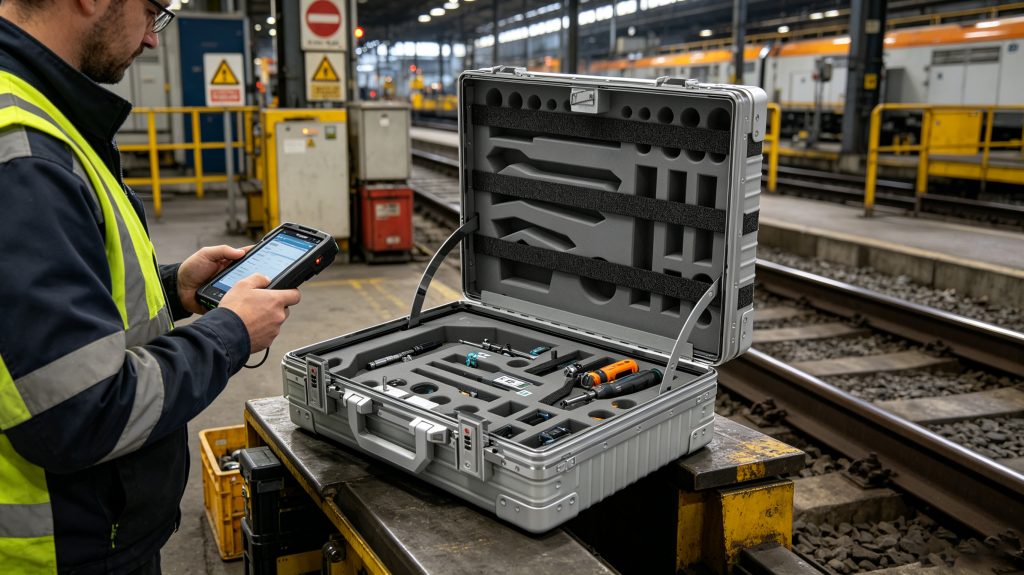
Integration with CYKEO-B2 smart tool system
The CYKEO-B2 RFID smart toolkit is a practical extension of on metal rfid tags in real-world operations.It enables:
This is especially important in high-risk environments such as:
Even a single missing wrench in these environments can lead to operational delays or safety risks.
Real operational workflow: how it works on-site
In a typical maintenance shift:The on metal rfid tags attached to each tool ensure stable detection even when tools are stacked, oily, or metallic.
Technical structure of on metal rfid tags
Layered RF architecture
Typical structure includes:This layered design prevents direct interference from conductive surfaces.
Frequency compatibility
Most industrial tags operate in:This ensures global interoperability across supply chain systems.
Industrial deployment scenarios
Common use cases:
Why it matters in practice:
Unlike barcode systems, RFID does not require line-of-sight scanning, which is critical when tools are inside cases, shelves, or stacked environments.Engineering insight: what field experience shows
In real deployments, engineers often report that:Experienced installers often test multiple mounting positions before final deployment rather than relying on theoretical read range.

Value of on metal rfid tags in automation systems
When integrated into industrial workflows, on metal rfid tags provide:In systems like CYKEO-B2, they become part of a closed-loop safety mechanism rather than just identification labels.


评论
发表评论