RFID Tool Management: How RFID Makes Tool Control Easier
RFID Tools & Devices: What Are They Really Used For?
Managing a few tools is easy.
Managing several hundred tools across a factory, maintenance workshop, aircraft hangar, construction site, or energy facility is a different story.
The problem usually isn’t the tools themselves. It is knowing which tool is available, who took it, when it was removed, whether it came back, and whether the inventory record is still correct.
This is where RFID tools and devices can make a practical difference.
An RFID tool management system typically combines RFID tags, RFID readers, rfid antennas, software, and a controlled storage or tracking point. Depending on the application, that tracking point could be a smart tool cabinet, mobile tool cart, handheld RFID reader, or another RFID-enabled device.
Instead of asking employees to scan every barcode one by one, the system can identify multiple tagged tools electronically and update the management system automatically.
Cykeo’s current RFID product range covers several of these building blocks, including RFID antennas, reader modules, fixed readers, USB readers, handheld and portable readers, RFID tags, and smart cabinets.
So, when people talk about RFID Tools & Devices, they are really talking about a complete ecosystem rather than one piece of hardware.
For companies looking to improve daily tool control, RFID tool management provides a practical way to automate tool identification, tracking, and check-in/check-out processes.
What Are RFID Tools & Devices?
The term RFID Tools & Devices can refer to the hardware and equipment used to identify, track, store, and manage physical tools with RFID technology.
A typical system may include:
- RFID tags attached to tools
- UHF RFID readers
- RFID antennas
- RFID-enabled tool cabinets
- RFID tool carts
- Handheld RFID scanners
- RFID tool bags or backpacks
- Access-control devices
- Tool management software
- Database or ERP integration
The exact configuration depends on the environment.
A factory tool room might use a fixed RFID cabinet. A maintenance technician working around a large facility may need a handheld reader or RFID backpack. An aircraft maintenance team may prefer a mobile RFID tool cart that can move directly to the work area.
In other words, there is no single RFID device that fits every tool management project.
The better question is:
Where does the tool need to be identified, and what needs to happen when the tool moves?
That question usually determines the hardware.
How Does RFID Tool Tracking Work?
At a basic level, RFID tool tracking is fairly simple.
Each tool receives an RFID tag containing a unique identification number.
The tag is detected by an RFID reader.
The reader sends the identification data to software.
The software then connects the tool with information such as:
- Tool ID
- Tool type
- Current status
- Assigned user
- Check-out time
- Return time
- Location
- Maintenance history
- Calibration information
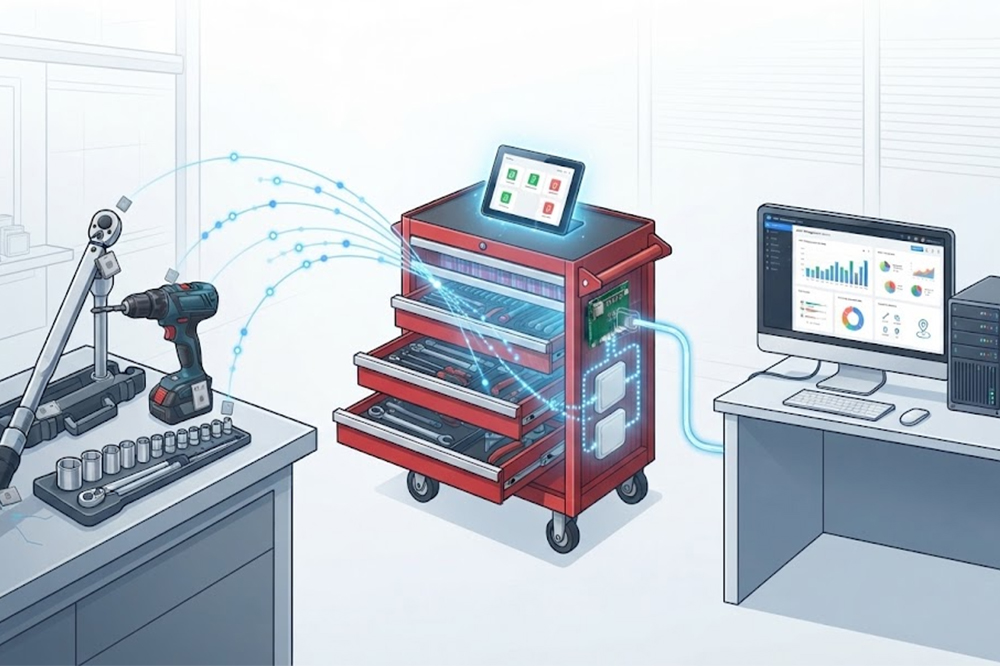
A simplified workflow looks like this:
RFID Tag → RFID Reader → Antenna → Software → Database / ERP
The advantage is that the employee does not necessarily need to scan every tool individually.
For a tool cabinet containing hundreds of items, this can make inventory checking much faster than manual counting.
Cykeo’s RFID tool cabinet range, for example, includes systems designed for automatic tool identification, inventory checking, access control, and check-in/check-out management.
The Main RFID Tools & Devices You Need to Know
Not every RFID project requires every device.
It helps to understand what each component actually does.
1. RFID Tags for Tools
The RFID tag is attached to the physical tool.
It provides the tool with a digital identity.
For industrial applications, tag selection matters more than many first-time buyers expect.
A metal wrench, torque tool, electronic instrument, plastic case, and power tool can all present different RFID conditions.
For metal tools, on-metal RFID tags are often a better choice than ordinary labels.
Other considerations include:
- Tag size
- Reading distance
- Mounting method
- Temperature resistance
- Water and oil exposure
- Impact resistance
- Metal compatibility
- Required memory
A good RFID tool tracking system starts with the tag—not the cabinet.
2. RFID Readers
The RFID reader is responsible for communicating with the tags.
Different applications call for different reader types.
Fixed RFID Readers
Fixed readers work well when tools pass through a defined location.
Typical applications include:
- Tool rooms
- Cabinets
- Gates
- Workstations
- Inventory stations
USB RFID Readers
USB readers are useful for desktop applications such as:
- Tool registration
- Tag encoding
- Asset identification
- Tool maintenance
- Manual verification
They can connect directly to a computer or industrial terminal. Cykeo also offers USB RFID readersUSB RFID Reader intended for controlled, short-range applications and software integration.
Handheld RFID Readers
Handheld devices make more sense when workers need to move around.
For example:
A technician walks through a maintenance area and wants to check a group of tools without bringing everything back to the tool room.
A handheld RFID reader can be much more convenient in that situation.
Long-Range RFID Readers
Long-range readers are more suitable for larger controlled reading zones, such as warehouse entrances, logistics areas, or equipment movement points.
3. RFID Antennas
The reader generates and processes the RFID signal, while the antenna helps create the actual RF reading area.
This becomes especially important inside an RFID tool cabinet.
A cabinet is not an empty open space. It contains:
- Steel panels
- Shelves
- Drawers
- Tools
- Metal surfaces
- Electronic components
These can affect RF performance.
That is why simply putting an RFID reader inside a metal cabinet does not automatically create a reliable tool tracking system.
A properly designed cabinet needs to consider antenna placement, tag orientation, cabinet structure, RF shielding, and reading zones.
4. RFID Tool Cabinets
This is where RFID tools and devices become a complete tool management solution.
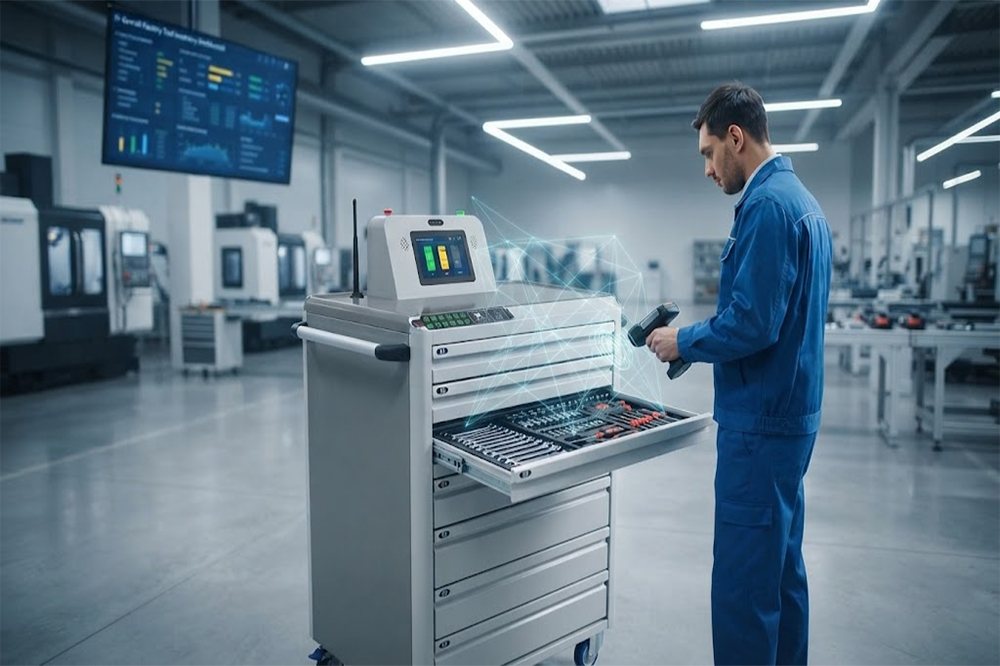
An RFID tool cabinet combines tool storage with RFID identification and management functions.
Instead of:
Tool → Cabinet → Manual Spreadsheet
the workflow becomes:
Tool → RFID Tag → Smart Cabinet → Software → Digital Record
A smart cabinet can potentially manage:
- Tool inventory
- Tool check-in
- Tool check-out
- User authentication
- Tool status
- Tool history
- Alerts
- Calibration reminders
- Inventory audits
Cykeo’s product category currently includes multiple RFID tool cabinet configurations, including intelligent tool cabinets, weighing cabinets, outdoor cabinets, compact cabinets, secure cabinets, and specialized aviation tool cabinets.
Explore Cykeo RFID Tool Cabinets
5. RFID Tool Carts
A cabinet works well when tools stay in one place.
But what if the tools need to move?
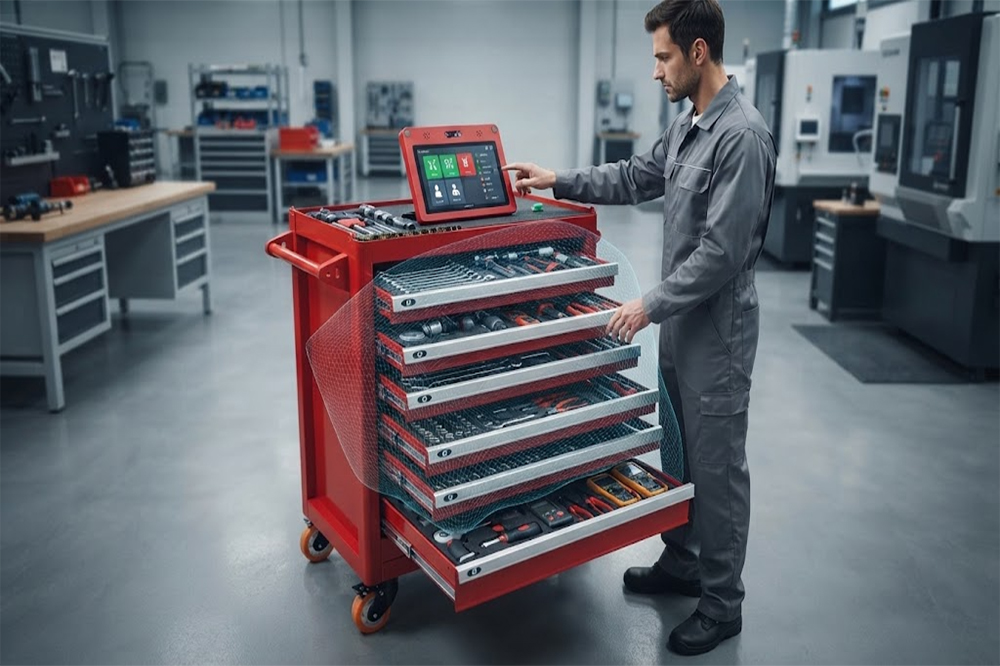
That’s where an RFID tool cart becomes useful.
An RFID tool cart can bring the tracking system directly to the work area.
This can be useful for:
- Aircraft maintenance
- Factory maintenance
- Power plant maintenance
- Construction
- Railway maintenance
- Industrial workshops
Cykeo’s product range includes several RFID tool cart configurations, including mobile carts, multi-drawer carts, workshop carts, and aviation maintenance carts.
For mobile operations, the cart can become the controlled tool storage point rather than simply a way to transport equipment.
6. RFID Tool Bags and Backpacks
Some technicians don’t work from a fixed workshop.
They move.
A field engineer may carry tools between machines, buildings, remote sites, or maintenance areas.
In this situation, a traditional RFID cabinet may not be practical.
An RFID tool bag or backpack provides another option.
The basic idea is straightforward:
Tools + RFID Tags + Portable RFID System = Mobile Tool Tracking
Cykeo currently lists an RFID smart tool bagCYKEO-B1 SMART RFID TOOL BAG and an industrial RFID backpack for field maintenance applications.
This type of device can be particularly interesting for field service and maintenance teams.
RFID Tool Cabinet vs RFID Tool Cart vs Handheld Reader
Choosing between these devices depends mainly on where the tracking needs to happen.
| Device | Best For | Main Advantage |
|---|---|---|
| RFID Tool Cabinet | Fixed tool rooms | Controlled storage |
| RFID Tool Cart | Mobile maintenance | Tracking while tools move |
| Handheld RFID Reader | Field inventory | Flexible scanning |
| USB RFID Reader | Desktop workstations | Simple integration |
| RFID Tool Bag | Field technicians | Portable tool management |
| Fixed RFID Reader | Defined reading points | Automated detection |
There is also nothing wrong with combining them.
For example, a large factory might use:
RFID Tool Cabinet + Handheld Reader + RFID Tags + Management Software
The cabinet manages controlled tool storage, while the handheld reader handles tools outside the cabinet.
What Can an RFID Tool Management System Track?
This is one of the most important questions for a buyer.
RFID does not just tell you that a tool exists.
When integrated with appropriate software, it can create a history around that tool.
For example:
Tool identity
Tool ID: TW-002581
Tool status
Status: Checked Out
User
User: Technician 018
Time
Checked out: 09:42 AM
Location
Location: Maintenance Area 03
Return
Status: Not Returned
This kind of information becomes useful when hundreds or thousands of tools are involved.
You can start answering questions that are difficult to answer with a paper-based system:
- Who has the tool?
- When was it taken?
- Has it been returned?
- How often is it used?
- Is it overdue?
- Does it require calibration?
- Is the tool missing?
- Which tools are rarely used?
That is where RFID starts moving beyond simple inventory counting.
RFID Tool Management in Different Industries
The right RFID device depends heavily on the industry.
Aviation and MRO
Aircraft maintenance has strict requirements around tool accountability.
An RFID system can help maintenance teams manage:
- Tool check-out
- Tool return
- Inventory verification
- Tool history
- FOD prevention workflows
- Calibration information
Mobile RFID tool carts and controlled tool cabinets are particularly relevant here.
Cykeo’s current product range includes RFID aviation tool cabinets and aviation maintenance carts aimed at MRO environments.
Manufacturing
Factories may have hundreds or thousands of tools distributed across production and maintenance departments.
RFID can help control:
- Tool rooms
- Maintenance tools
- Production tools
- Measuring instruments
- Spare equipment
A fixed smart cabinet is often appropriate when tools are issued from a central location.
Construction
Construction sites have a different challenge.
Tools move constantly.
Workers may take equipment from a central storage area and use it across different work zones.
RFID can provide better visibility into:
- Tool allocation
- Tool return
- Missing tools
- Team responsibility
- Site inventory
For larger projects, combining smart cabinets with mobile RFID devices can make more sense than relying on one fixed scanning point.
Oil & Gas
Oil and gas environments often involve remote sites and demanding working conditions.
Tool management may need:
- Rugged hardware
- Environmental protection
- Controlled access
- Fast inventory checks
- Remote connectivity
- Digital records
Cykeo’s RFID tool cabinet portfolio includes industrial and outdoor configurations designed around applications such as oil, gas, mining, and energy.
RFID Tool Tracking Is More Than Cabinet
This is an important distinction.
Some buyers initially search for an RFID tool cabinet when what they actually need is an RFID tool management system.
The cabinet is only one part.
A complete system can look like this:
                    RFID TOOL MANAGEMENT
                            │
        ┌───────────────────┼───────────────────┐
        │                   │                   │
     RFID Tags           RFID Devices        Software
        │                   │                   │
   Tool Identity      ┌─────┼─────┐       Database
                      │     │     │           │
                   Reader Antenna Cabinet     │
                      │           │            │
                 Handheld      Tool Cart       │
                                              ERP
The quality of the final solution depends on how well these pieces work together.
This is also why RFID tool management projects should not be evaluated only by the reader’s advertised reading distance.
Can RFID Tool Cabinets Connect to ERP Systems?
Yes, depending on the cabinet and software architecture.
For larger organizations, the RFID system may need to communicate with existing enterprise software rather than operate as an isolated database.
Possible integration targets include:
- SAP
- Oracle
- MES
- WMS
- ERP
- Maintenance systems
- Custom databases
Cykeo’s industrial RFID tool cabinet products include SAP/Oracle integration options, while some products also support software development and integration capabilities.
This matters because the goal isn’t simply to create another inventory database.
The goal is to make RFID-generated tool data useful inside the company’s existing workflow.
How Accurate Is RFID Tool Tracking?
There isn’t one universal RFID accuracy number.
Real-world performance depends on several factors:
- RFID tag quality
- Tool material
- Metal interference
- Tag position
- Reader power
- Antenna layout
- Cabinet construction
- Number of tags
- Reading environment
- Software filtering
Metal tools deserve particular attention.
A tag that performs well on plastic may behave differently when attached directly to steel.
The same applies inside a cabinet packed with hundreds of metal objects.
This is why a real RFID tool management project should be tested with the actual tools and actual storage environment, not just a sample tag on a desk.
How to Choose RFID Tools & Devices
Before buying equipment, answer these questions.
1. How many tools need to be managed?
Managing 50 tools is different from managing 5,000.
2. Are the tools mostly metal?
If yes, pay close attention to on-metal RFID tags and RF design.
3. Do tools stay in one location?
If yes, consider an RFID tool cabinet.
4. Do tools move between work areas?
If yes, look at RFID carts or handheld readers.
5. Do users need controlled access?
If yes, the cabinet should support user authentication and access control.
6. Do you need automatic check-in/out?
If yes, look for a complete RFID cabinet or integrated tracking system rather than a basic RFID reader.
7. Does the system need ERP integration?
If yes, check API, SDK, database, SAP, Oracle, or other integration capabilities before selecting hardware.
8. Will the equipment be used outdoors?
Then environmental protection, temperature range, power supply, and connectivity become important.
9. How fast does inventory need to be checked?
For large tool inventories, fast bulk identification can be one of the biggest advantages of RFID.
10. Do you need a customized solution?
For larger projects, the cabinet, reader, antenna, software, and interface may need to be configured around the customer’s actual workflow.
RFID Tools & Devices: A Practical System Example
Imagine a maintenance department with 800 tools.
Previously:
- Tools stored in a normal cabinet
- Employees write down what they take
- Inventory is checked manually
- Missing tools are discovered later
- Managers have limited usage data
After RFID implementation:
Step 1:
Each tool receives an RFID tag.
Step 2:
Tools are registered in the management system.
Step 3:
The tools are placed inside an RFID-enabled cabinet.
Step 4:
An employee authenticates before accessing the cabinet.
Step 5:
The employee removes a tool.
Step 6:
The RFID system records the transaction.
Step 7:
The employee returns the tool.
Step 8:
The system updates the inventory.
Now the tool cabinet is no longer just storage.
It becomes a digital control point for the company’s tools.
What Is the Future of RFID Tool Management?
RFID tool management is moving toward more connected systems.
Instead of only asking:
“Is the tool here?”
companies increasingly want to know:
“What happened to this tool throughout its lifecycle?”
That can include:
- Tool usage history
- Maintenance records
- Calibration schedules
- User responsibility
- Automated alerts
- ERP synchronization
- Predictive maintenance
- Mobile management
- Remote monitoring
The hardware will remain important, but the bigger value comes from connecting the hardware with the company’s workflow.
Final Thoughts: Choosing the Right RFID Tools & Devices
There is no single “best” RFID device for every tool management application.
A small workshop may only need RFID tags and a USB reader.
A factory tool room may need a smart RFID cabinet.
An aviation maintenance team may need RFID carts and controlled cabinets.
A field service company may be better served by handheld readers, RFID bags, or backpacks.
For larger industrial projects, the solution can combine all of them.
The important thing is to start with the tool management problem, not the hardware catalog.
If your main goal is automatic tool inventory, controlled tool access, check-in/check-out, and centralized management, an RFID Tool Cabinet is often a practical starting point.
If the tools also need to move between work areas, an RFID tool cart or portable RFID device can extend the system beyond the cabinet.
And when the project grows, RFID readers, antennas, tags, software, and ERP integration can be combined into a complete tool tracking platform.
For businesses evaluating RFID tools and devices for industrial tool management, Cykeo’s RFID Tool Cabinet range provides a useful starting point for comparing fixed smart cabinets, weighing cabinets, outdoor cabinets, tool carts, and other RFID-enabled tool management equipment.


评论
发表评论