RFID Tool Inventory Management: Faster Tool Counting with RFID
Tool inventory sounds easy until the number of tools starts growing.
A small workshop may manage a few dozen tools without much trouble. But in a large factory, maintenance center, aviation facility, or service department, hundreds or thousands of tools can move between storage areas and employees every day.
At that point, counting everything manually becomes a time-consuming job.
Employees may need to check each tool, record its number, compare it with a spreadsheet, and investigate anything that appears to be missing. Even after all that work, the inventory record can become outdated as soon as another tool leaves the storage area.
RFID tool inventory management offers a different approach.
By attaching RFID tags to tools and using UHF RFID readers to identify multiple items automatically, companies can make routine inventory checks faster and create a more consistent digital record.
What Is RFID Tool Inventory Management?
RFID tool inventory management is the use of RFID technology to identify, count, and manage tools within a defined storage or working environment.
A typical system includes:
- UHF RFID tags
- RFID readers
- RFID antennas
- RFID tool cabinets or storage areas
- Inventory management software
- Database or ERP integration
Each tool is assigned a unique RFID identity.
When the tool passes through an RFID reading zone, the reader detects the tag and sends the information to the software. The system can then compare the detected tools with the expected inventory.
This makes it possible to identify which tools are present, which are missing, and which may be in the wrong location.
Why Manual Tool Inventory Becomes Difficult
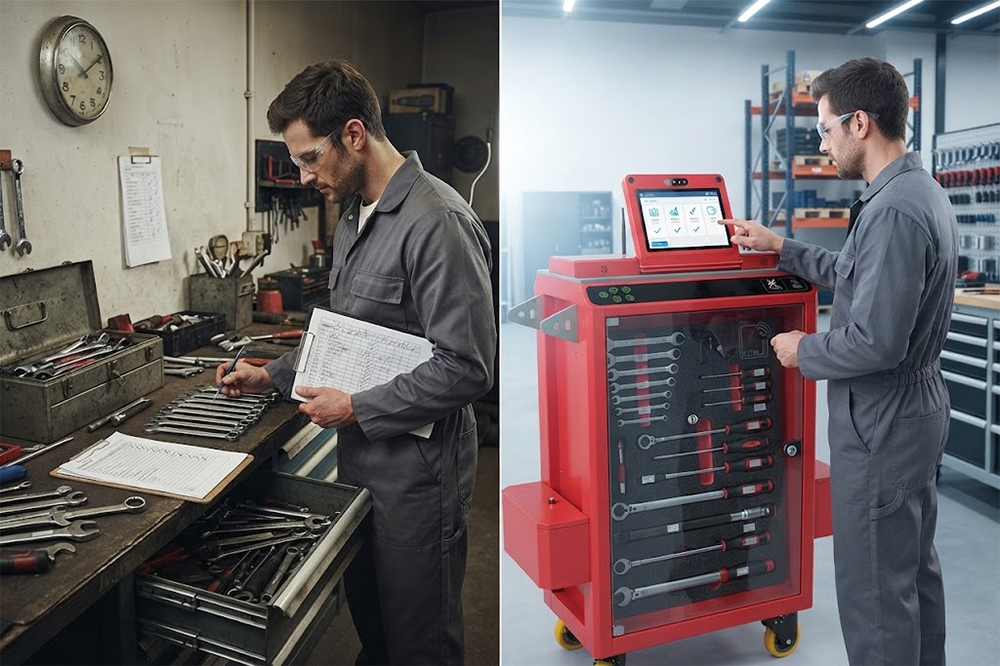
Manual inventory works reasonably well when the tool collection is small and stable.
The problems usually appear when tools are shared between multiple teams.
A technician takes a torque wrench from storage. Another employee borrows a socket set. A third person moves several tools to another workshop.
If every movement is not recorded correctly, the inventory list gradually loses accuracy.
There are also practical problems.
Some tools may be stored behind other equipment. Some may be returned to the wrong drawer. Others may be left on workbenches or inside maintenance vehicles.
A physical inventory count can take hours, particularly when every item has to be checked individually.
RFID does not eliminate the need for inventory control, but it can reduce the amount of manual identification required.
How Does RFID Tool Inventory Work?
The process is relatively straightforward.
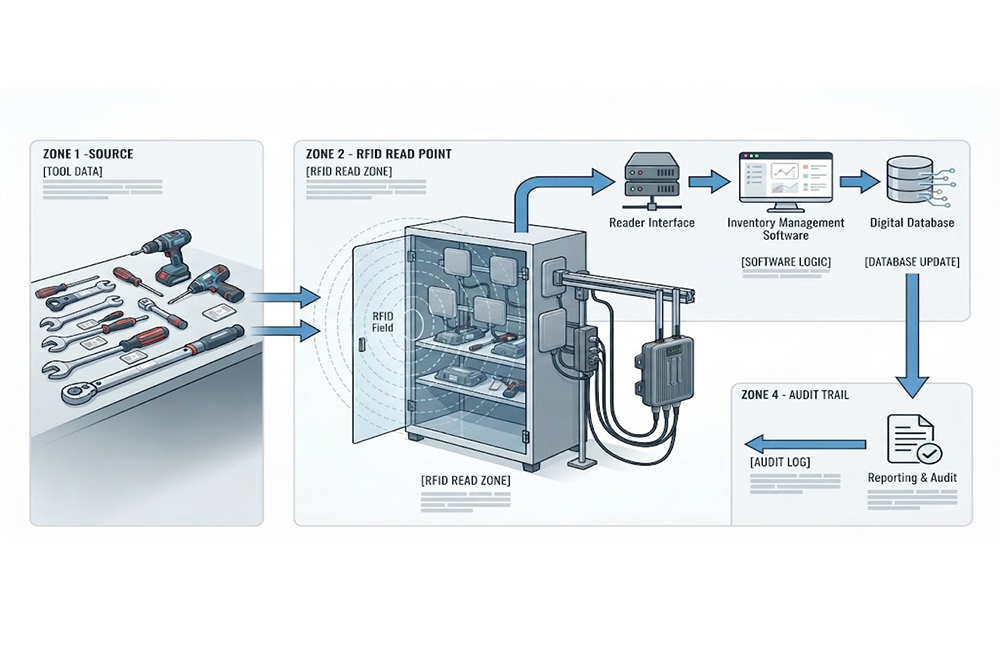
Step 1: RFID Tags Are Assigned to Tools
Each tool receives an RFID tag with a unique identification number.
The tag becomes the digital identity of the physical tool.
For metal tools, companies generally need to consider tags designed for metal surfaces. The tag should also be mounted in a position that provides reliable performance.
Step 2: RFID Readers Scan the Storage Area
An RFID reader creates a reading zone using one or more antennas.
Depending on the application, the reader may be installed inside an RFID tool cabinet, at a storage entrance, on a mobile cart, or in another controlled location.
The reading zone should be designed carefully.
The objective is to detect the tools that should be detected without creating excessive reads from nearby areas.
Step 3: The System Compares the Results
After the RFID reader identifies the tags, the software compares the detected tools against the expected inventory.
For example:
Expected inventory: 100 tools
Detected inventory: 98 tools
The system can flag two tools for investigation.
The missing tools may have been checked out, moved to another location, or simply returned incorrectly.
This is much easier to investigate when the system already has a record of previous tool activity.
RFID Can Count Multiple Tools at Once
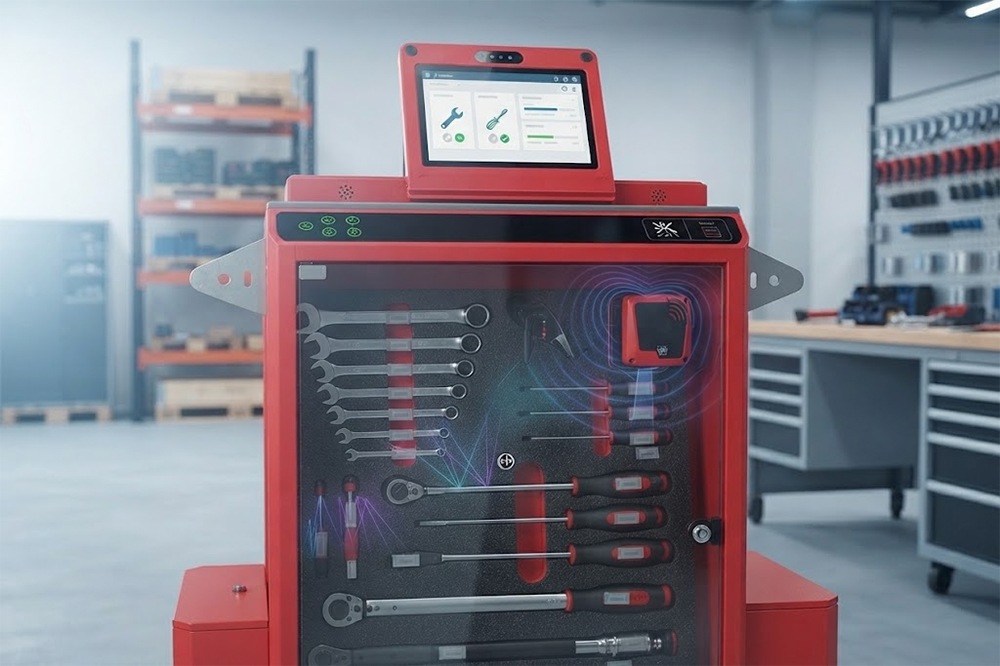
One of the main advantages of UHF RFID is that it can identify multiple tags within a suitable reading area.
With a traditional barcode process, an employee normally needs to position each item so the barcode scanner can read it.
RFID works differently.
A reader can detect several tagged tools without requiring the user to scan each tag individually.
This can be especially useful for tool cabinets and storage areas containing many items.
However, “automatic” does not mean “works perfectly in every environment.”
Tool material, tag orientation, cabinet construction, antenna position, RF interference, and tag density can all affect performance.
Testing real tools before deployment is therefore important.
RFID Tool Inventory vs RFID Tool Tracking
These two concepts are closely related, but they solve slightly different problems.
RFID tool inventory management focuses on what tools are available and whether the physical inventory matches the system records.
RFID tool tracking focuses more on where tools move, who uses them, and what happens during their lifecycle.
For example:
Inventory management may tell you:
250 tools should be inside the tool room.
Tracking can help answer:
Where did the missing tool go?
The two functions work better together.
When inventory data and movement history are connected, managers can investigate discrepancies more quickly.
For a broader explanation of this relationship, see our guide to RFID tool tracking.
RFID Tool Cabinets Make Inventory Checks Easier
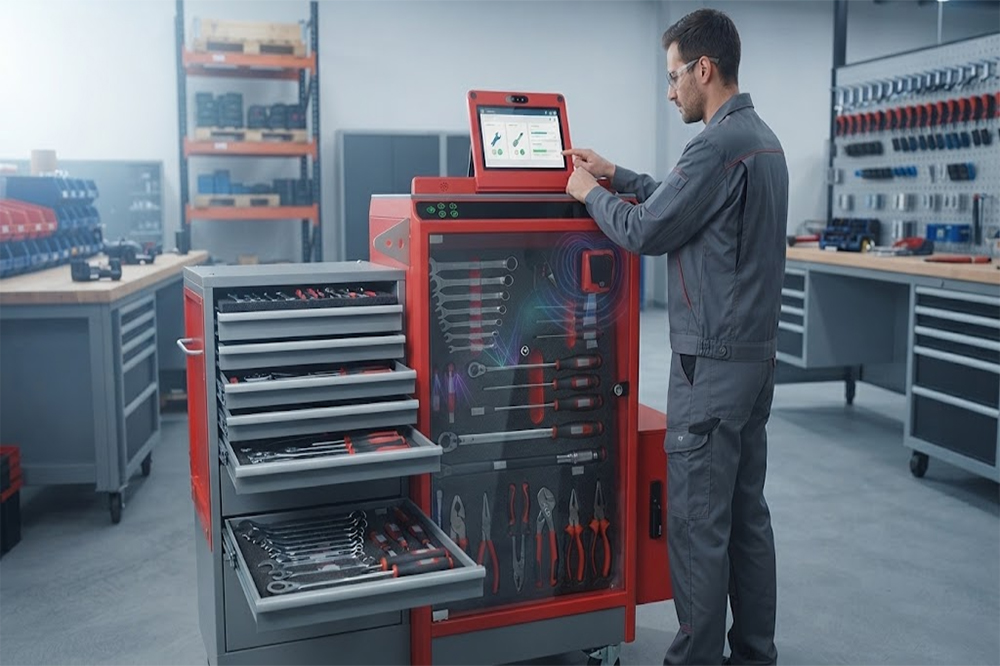
An RFID tool cabinet provides a controlled storage environment for tagged tools.
Instead of manually opening drawers and counting tools, the cabinet can use RFID technology to identify the tools inside.
The software can then display inventory information and highlight exceptions.
This can help answer simple but important questions:
- Is the tool in the cabinet?
- Is something missing?
- Has a tool been returned?
- Is the tool assigned to another user?
- Does the cabinet inventory match the database?
For organizations with centralized tool storage, this approach can combine inventory management with access control and tool checkout.
What About Missing Tools?
Missing tools are one of the reasons companies consider RFID inventory systems in the first place.
A missing tool doesn’t necessarily mean it has disappeared permanently.
It could be:
- Checked out by an employee
- Moved to another department
- Left at a maintenance location
- Stored in the wrong cabinet
- Waiting for repair
- Returned without being recorded
RFID gives managers more information to work with.
If the system records tool movement and user activity, staff can check the last known status before starting a physical search.
This can save time, particularly when the missing item is expensive or urgently needed.
Improving Inventory Accuracy
RFID can improve inventory accuracy by reducing manual data entry.
A spreadsheet depends on someone updating it correctly.
An RFID system can automatically capture identification data when tools pass through a reading zone.
That reduces some common sources of human error, such as:
- Forgetting to record a tool
- Entering the wrong tool number
- Missing an item during counting
- Recording the wrong quantity
- Forgetting to update a return
Still, RFID should not be viewed as a magic solution.
Good inventory accuracy depends on the complete system, including reliable tags, appropriate hardware, correct installation, and properly configured software.
How Often Should RFID Tool Inventory Be Checked?
There is no universal answer.
Some companies may perform an automated inventory check whenever tools enter or leave a cabinet.
Others may use scheduled checks several times a day.
For high-value tools, more frequent verification may make sense.
For less critical equipment, daily or weekly inventory checks may be enough.
The important point is that RFID makes frequent checking more practical because the system can automate much of the identification process.
Choosing an RFID Tool Inventory System
Before buying equipment, consider how your tools are actually used.
Start with the inventory itself.
How many tools need to be managed?
Are most tools made of metal?
Are tools stored in cabinets, drawers, carts, or open shelves?
How often do tools move?
Do several employees share the same equipment?
The answers will influence the choice of RFID tags, readers, antennas, cabinets, and software.
It is also worth considering future expansion.
A system designed for 200 tools may need to support 1,000 tools later.
Software integration matters as well. If the company already uses an ERP, maintenance management system, or warehouse platform, RFID inventory data may need to connect with those systems.
Final Thoughts
RFID tool inventory management can make routine tool counting faster and easier, especially when organizations manage large numbers of shared or frequently moved tools.
The technology works best when RFID tags, readers, antennas, storage equipment, and software are designed as one system.
The real benefit is not simply counting tools faster.
It is having a clearer picture of what tools are available, what is missing, where discrepancies occur, and what action needs to be taken.
For companies that already use RFID tool tracking, adding inventory management is a natural next step toward a more complete RFID tool management system.
RFID tool inventory management combines several technologies, including RFID tags, readers, antennas, cabinets, and software, all of which are part of the broader RFID Tools & Devices ecosystem.
Inventory is only one part of the process. For a broader look at managing tools with RFID, see our guide to RFID tool management.
When an inventory discrepancy appears, RFID tool tracking can help managers understand where the tool moved and who last used it.
Frequently Asked Questions
1. What is RFID tool inventory management?
RFID tool inventory management uses RFID tags, readers, antennas, and software to automatically identify tools and compare physical inventory with digital records.
2. Can RFID count multiple tools at once?
Yes. UHF RFID can identify multiple tagged tools within a suitable reading zone, reducing the need to scan every tool individually.
3. Can RFID track metal tools?
Yes. Suitable on-metal RFID tags can be used for metal tools. Tag design, mounting position, antenna layout, and reader configuration should be tested for reliable performance.
4. How does RFID help find missing tools?
RFID can show whether a tool was detected, checked out, returned, or moved through a particular reading point. This information can help staff investigate missing equipment more quickly.
5. Can RFID inventory systems connect with ERP software?
Yes. Depending on the system design, RFID inventory data can be connected with ERP, warehouse, maintenance, or other business management software through APIs or supported interfaces.


评论
发表评论