Long Range RFID Scanner for Asset Tracking: How to Track Tools, Equipment, and Containers
A long range RFID scanner can automatically identify tagged tools, equipment, carts, containers, and other reusable assets as they move through designated areas. It helps companies reduce manual asset checks and build a more accurate record of where assets were last detected.
A missing tool doesn’t always look like a serious problem when you have hundreds of other tools.
Until someone needs it.
Then the search starts.
A technician checks the workshop. Someone calls another department. Another person looks in a storage room. Ten or twenty minutes later, everyone is still asking the same question: where was it last used?
This is one of the practical reasons companies consider RFID asset tracking.
By attaching an RFID tag to tools, equipment, carts, containers, or other reusable assets, a long range RFID scanner can automatically detect those assets when they pass through selected locations.
The goal isn’t to create a magical real-time map of every object in a factory.
The more realistic goal is often simpler:
Know what was detected, where it was detected, and when it was detected.
That information alone can save a surprising amount of time.
What Can RFID Asset Tracking Actually Track?
RFID can be used with many types of reusable assets.
Examples include:
- Hand tools
- Power tools
- Maintenance equipment
- Production fixtures
- Test equipment
- Toolboxes
- Carts
- Plastic containers
- Metal bins
- Pallets
- Transport racks
- Maintenance kits
- Industrial components
- Rental equipment
The RFID tag gives each asset a unique identification number.
When the asset enters an RFID reading zone, the reader detects the tag and sends the identification data to the asset management system.
The software can then associate the event with a location.
For example:
Tool ID 00258 → Maintenance Room → 14:32
Later:
Tool ID 00258 → Production Area B → 15:06
That is already much more useful than a simple inventory list.
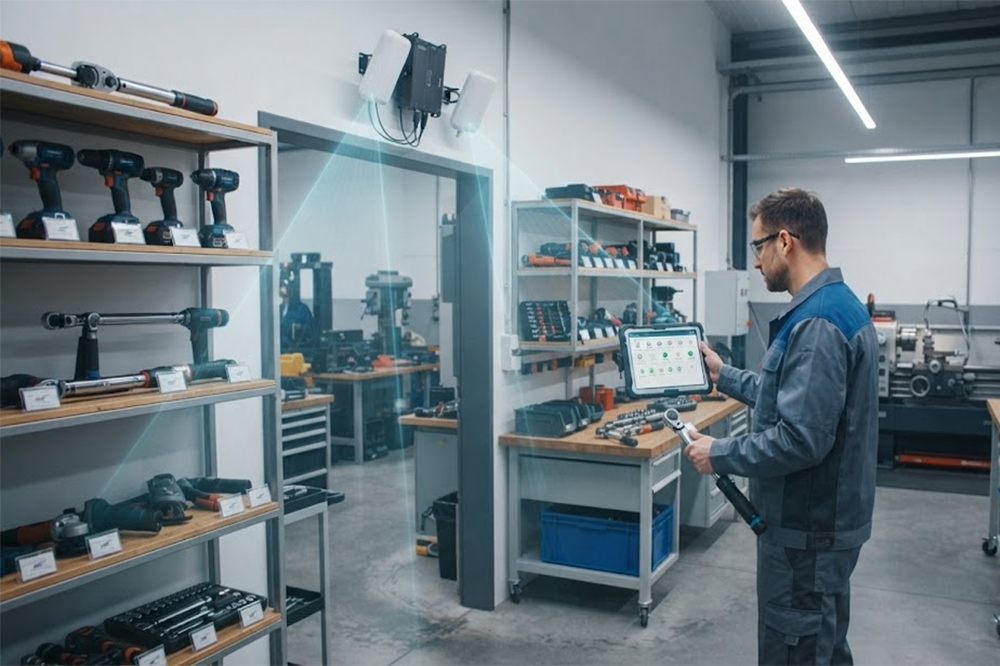
RFID Is Especially Useful for Moving Assets
Traditional inventory counting works reasonably well when equipment stays in one place.
The problem starts when assets move.
Tools move between departments. Containers move between factories. Carts move from production to storage. Maintenance equipment can spend the whole day traveling around a facility.
A barcode label can identify these assets, but someone normally needs to scan it.
RFID can work differently.
A fixed long range RFID scanner can be installed at a doorway, production entrance, warehouse gate, or equipment room.
When a tagged asset passes through the area, the system can automatically record the detection.
This is where fixed RFID readers often make more sense than handheld scanners.
A handheld RFID reader is useful when someone needs to search a particular area.
A fixed reader is useful when you want the system to automatically capture movement.
In many projects, the two approaches work together.
Where Should the RFID Reader Be Installed?
This is one of the first questions an RFID system integrator should ask.
There is no universal “best” position.
The installation depends on how the asset moves.
Common locations include:
Tool Room Entrances
A reader can detect tools entering or leaving a controlled tool room.
This can create a basic checkout and return history without requiring workers to scan every tool manually.
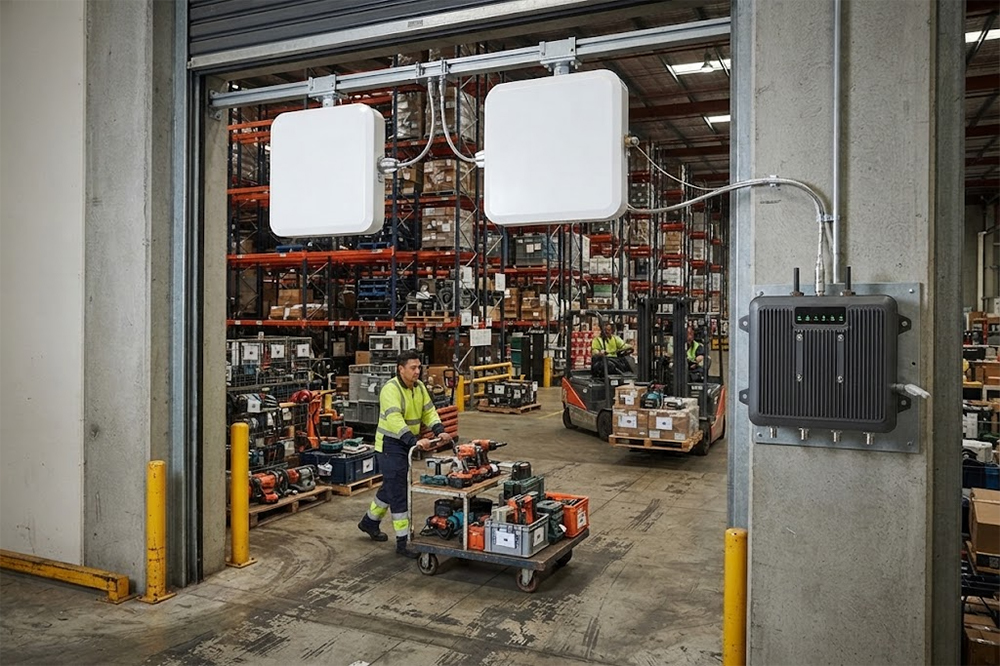
Warehouse Doors
A long range RFID scanner can identify tagged containers, carts, pallets, or equipment moving through a warehouse entrance.
Production Areas
Readers can be positioned between production zones to record equipment movement.
Maintenance Departments
RFID can help track tools and test equipment moving between maintenance rooms and production areas.
Loading Areas
Reusable containers and transport equipment can be identified when they leave or return to a facility.
The key is to place the reader where the asset naturally passes.
Don’t Try to Read the Whole Factory
This sounds obvious, but it is worth mentioning.
If a customer says, “We want one RFID reader to track every tool in a 500-square-meter workshop,” I would immediately ask how they expect the system to know which room the tool is in.
RFID detection is not the same thing as precise indoor positioning.
A long range reader can detect a tag within its RF coverage, but that doesn’t automatically tell you the exact physical coordinates of the asset.
For asset tracking, controlled checkpoints are often easier to manage.
For example:
- Tool room
- Assembly area
- Maintenance room
- Warehouse
- Shipping area
Each reader represents a known detection point.
The software then builds an asset movement history from those events.
Antenna Direction Helps Control the Reading Area
Reader power isn’t the only way to influence RFID performance.
Antenna direction is equally important.
Suppose a reader is installed near a doorway.
If the antenna faces directly toward the passage, the system can create a relatively controlled reading area.
If antennas are positioned carelessly, the reader may detect tags outside the intended zone.
That can produce confusing records.
A tool might still be inside the workshop, but the system could detect it near the doorway and record a movement event.
For this reason, antenna installation should be tested at the actual site rather than decided only from a specification sheet.
Tool Tracking Has Some Special Challenges
RFID tool tracking sounds straightforward until you look at the tools themselves.
Many industrial tools contain metal.
Some have motors.
Others contain batteries or electronic components.
And tools are often stored tightly together.
A standard RFID label may not perform well when attached directly to a metal surface.
An on-metal RFID tag is usually a better starting point.
The physical position also matters.
For example, attaching a tag to the end of a metal tool may produce a very different result from attaching it near the handle.
Before standardizing the tag, test:
- Tool material
- Tag position
- Tag orientation
- Storage method
- Distance between tools
- Reader antenna position
A few minutes of testing can prevent a lot of troubleshooting later.
What About Metal Containers?
Metal containers are another common RFID application.
A metal bin can interfere with a standard RFID tag, especially when the tag is mounted directly against the metal surface.
For this application, a suitable on-metal tag can improve consistency.
The antenna setup matters too.
If dozens of metal containers are stacked together, the reader may not see every tag in exactly the same way.
So don’t assume that “long range” means every container will be read from a long distance.
The effective reading distance depends on the complete combination of:
Reader + antenna + RFID tag + mounting surface + environment
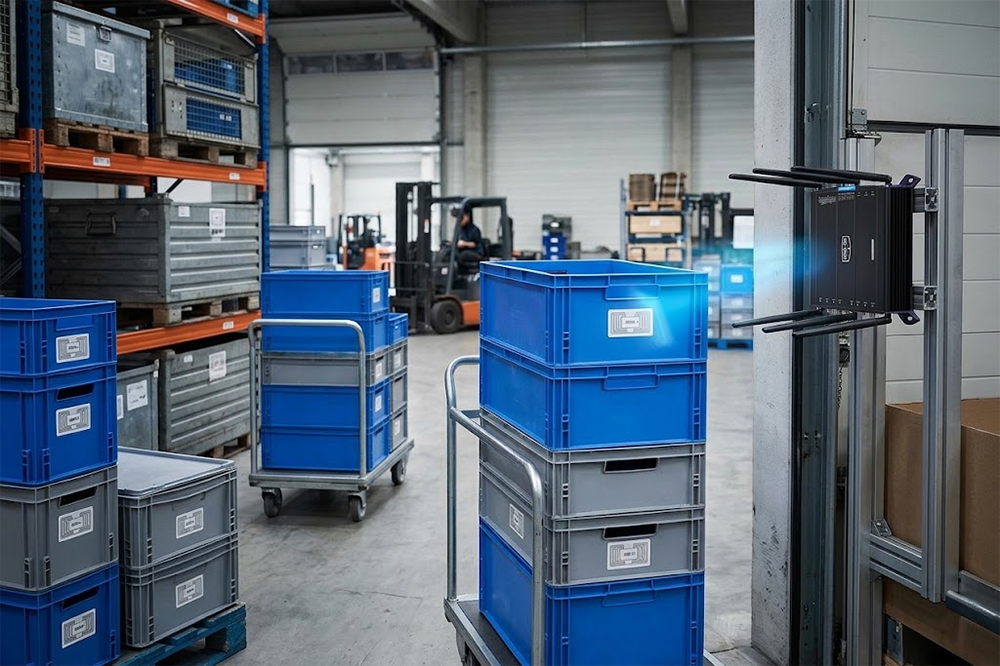
RFID Can Reduce Manual Asset Checks
Consider a factory with 300 reusable production containers.
Every Friday, someone needs to count them.
The traditional process might involve walking around the facility, checking storage areas, and manually recording quantities.
With RFID, fixed readers can automatically record container movements at selected checkpoints.
A handheld RFID scanner can then be used for periodic verification.
The result isn’t necessarily a completely hands-free inventory system.
Instead, RFID reduces the amount of routine manual checking.
That distinction makes the business case easier to understand.
RFID Software Is What Makes the Data Useful
A reader detecting EPC numbers is only the first step.
Imagine the reader reports:
- EPC001
- EPC002
- EPC003
- EPC004
That’s useful for an engineer testing the hardware.
It isn’t enough for an asset manager.
The software needs to translate those EPCs into information such as:
- Asset name
- Asset type
- Department
- Current status
- Last detected location
- Last detected time
- Maintenance status
- Assigned user
- Movement history
The RFID reader provides identification.
The asset management software provides meaning.
This is why RFID projects often require integration with ERP, MES, WMS, maintenance software, or custom asset management platforms.
A Simple RFID Tool Tracking Example
Imagine a maintenance department with 150 tools.
A fixed RFID reader is installed at the entrance.
Each tool receives an RFID tag.
When a technician takes a tool out, the reader detects it.
When the tool comes back, another detection event is generated.
The software can then show:
Tool: Electric Torque Wrench 08
Last Location: Production Area 3
Last Detected: 10:46
Status: In Use
If the tool doesn’t return by the expected time, the system can flag it for checking.
This isn’t complicated technology.
The difficult part is designing the reading zone so that the system generates reliable events.
Long Range Does Not Always Mean Better
This is another point worth keeping in mind when selecting a reader.
If you are tracking equipment through a doorway, you don’t necessarily want the reader to detect the same tool from 15 meters away.
You may only want to know when it crosses the doorway.
A smaller, controlled reading area can actually produce better asset tracking data.
The goal should be reliable detection at the correct location, not simply the maximum reading distance.
What Should System Integrators Test?
Before deploying an RFID asset tracking system, test the complete environment.
At minimum:
- Actual RFID tags
- Actual tools or containers
- Tag mounting position
- Reader power
- Antenna direction
- Antenna height
- Reading distance
- Asset movement speed
- Multiple assets together
- Metal surfaces
- Nearby RFID readers
- Doorway or checkpoint layout
- Software event filtering
Try the system with realistic movement.
Don’t only hold one RFID tag in front of the antenna.
Walk through the doorway carrying several tagged tools.
Push a cart through.
Move multiple containers together.
Test the conditions that workers will actually create.
That’s where the useful information appears.
What Should Buyers Check When Purchasing in Bulk?
For distributors and RFID solution providers, several hardware specifications deserve attention:
- Frequency range
- RFID protocol
- Reader chipset
- Output power
- Receiver sensitivity
- Antenna ports
- Communication interfaces
- GPIO or digital I/O
- API/SDK support
- Network connectivity
- Firmware
- Enclosure design
- OEM customization
- Sample availability
- MOQ
- Lead time
- Bulk pricing
- Technical support
If the project involves tools, containers, or industrial equipment, also ask about compatible on-metal RFID tags and antennas.
A complete product combination is usually more valuable than a reader sold without application support.
Test the Asset, Not Just the Reader
For RFID asset tracking, the actual asset should be part of the test.
A reader may perform well with a small paper RFID label but poorly with a steel toolbox.
It may read one empty container easily but struggle when the container is filled with metal components.
It may work perfectly at the entrance but create unwanted reads from nearby storage racks.
These are normal engineering issues.
They don’t necessarily mean RFID isn’t suitable.
They mean the system needs to be adjusted around the real application.
For manufacturers, warehouse operators, RFID distributors, and system integrators, a sample test is usually the fastest way to find out whether a particular reader, antenna, and tag combination will work.
If an RFID asset tracking system is not reading consistently, it is worth checking the tag, antenna position, reader power, and surrounding materials. These issues are also common in long range RFID scanner reading problems.
For assets moving through warehouse entrances, controlling the reading area is especially important, just as it is when reducing RFID misreads at warehouse gates.
Reusable pallets and transport containers can also become part of a broader RFID pallet tracking system when they move between warehouses and production areas.
FAQs
1. What assets can RFID track?
RFID can track tools, equipment, carts, pallets, reusable containers, production fixtures, maintenance kits, and many other physical assets. The main requirement is that the asset can carry a suitable RFID tag.
2. Can RFID track metal tools?
Yes. Metal tools can be tracked with suitable on-metal UHF RFID tags. Tag placement is important because mounting the tag directly against metal can significantly affect RFID performance.
3. Can one RFID reader track assets throughout a factory?
Usually, a single reader is not the best solution for tracking assets across an entire facility. Fixed readers are normally installed at specific checkpoints so that each RFID detection corresponds to a known location.
4. Can RFID tell the exact location of an asset?
Not automatically. A standard fixed RFID reader generally tells the system that a tag was detected within its reading area. Multiple readers or more advanced positioning technologies may be needed for more detailed location information.
5. Should I use fixed or handheld RFID readers?
They serve different purposes. Fixed readers are useful for automatically recording asset movement at doors and checkpoints. Handheld readers are useful for searching, auditing, or locating tagged assets in a specific area. Many systems use both.


评论
发表评论