How RFID Is Used in Inventory Management: Complete Guide to Smart Stock Control
How RFID Is Used in Inventory Management
How rfid is used in inventory management is through automatic product identification, real-time tracking, and digital inventory updates. RFID tags and readers help businesses monitor stock movement, reduce manual errors, and maintain accurate inventory information across warehouses, stores, and supply chains.
How RFID Is Used in Inventory Management Today
Inventory management has changed from simple counting into a continuous data process.
Modern warehouses, retailers, hospitals, and manufacturers need to know more than how many products they own.
They need to know:
- Where each item is located
- When it moved
- Who handled it
- Whether the inventory record matches reality
During RFID system deployments I have participated in, one recurring scene appeared frequently:
A warehouse management system showed 200 units available, but workers could only locate 186 units on the shelves.
The missing 14 items were not necessarily lost.
They were often somewhere between receiving, storage, transfer, or shipment.
This is where RFID creates a different approach.
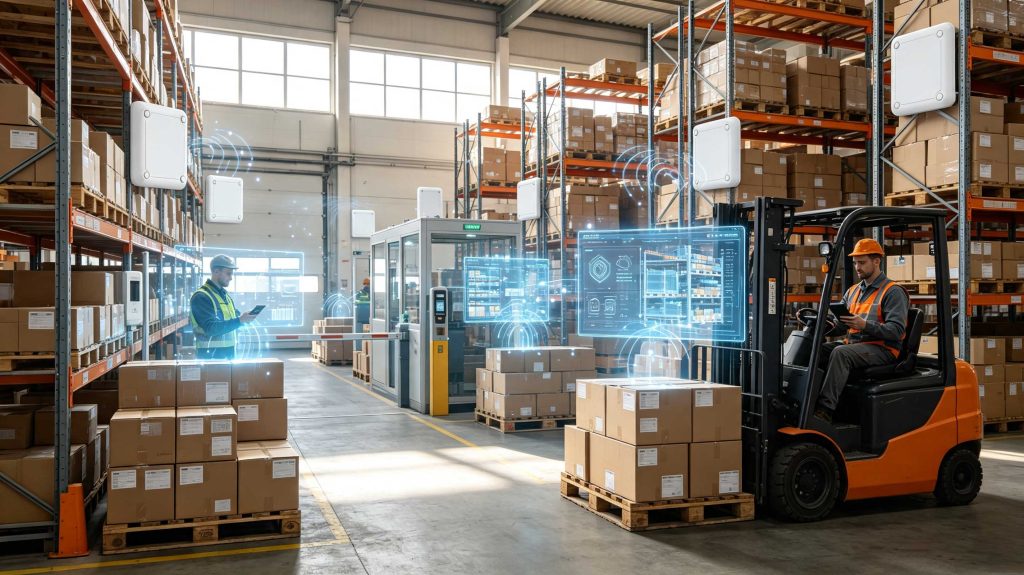
Instead of relying on periodic manual checks, RFID continuously connects physical products with digital inventory systems.
The basic process is:
- RFID tags are attached to products.
- RFID readers capture product information wirelessly.
- Software updates inventory records automatically.
- Managers receive real-time visibility.
This is the practical answer to how rfid is used in inventory management.
According to GS1, RFID enables automatic identification and data capture by using radio communication between RFID tags and readers, supporting supply chain visibility and operational efficiency.
RFID Inventory Management Working Process
A complete RFID inventory system contains several connected components.
| Component | Function |
|---|---|
| RFID Tags | Store unique product identity information |
| RFID Readers | Capture product data wirelessly |
| RFID Antennas | Extend and control reading coverage |
| Software Platform | Processes inventory information |
| Enterprise System | Uses data for business decisions |
How RFID Tags Support Inventory Management
1. Assigning Digital Identity to Products
Every RFID-tagged product receives a unique electronic identity.
Unlike traditional labels, RFID tags allow individual item recognition.
For example:
A warehouse may contain thousands of identical products.
Barcode:
- Same product code
- Manual scanning required
RFID:
- Individual identification
- Automatic recognition
- Movement history available
This difference is important for industries managing large inventories.
2. Capturing Product Movement Automatically
Inventory accuracy depends on knowing when products move.
RFID readers can collect information when products:
- Enter warehouses
- Leave storage areas
- Move between departments
- Pass checkout stations
The system records these events without requiring employees to manually update every transaction.
3. Updating Inventory Data in Real Time
Traditional inventory systems often depend on scheduled counting.
RFID provides continuous information flow.
Examples:
A retailer receives new products.
RFID automatically records incoming inventory.
A customer purchases an item.
The system updates stock availability.
A warehouse ships products.
Inventory records change immediately.
Why Companies Use RFID for Inventory Management
Improved Inventory Accuracy
Manual inventory counting creates unavoidable risks.
Common problems include:
- Incorrect counting
- Missed product movement
- Delayed updates
- Human recording errors
RFID reduces these problems by automating identification.
Research from Auburn University RFID Lab has shown that RFID-based retail implementations can significantly improve inventory accuracy, with many deployments achieving accuracy levels above 95%.
Faster Inventory Counting
One of the strongest RFID advantages is speed.
Traditional counting:
- Product by product scanning
- Manual recording
- Longer operation time
RFID counting:
- Multiple item identification
- Faster inventory checks
- Reduced labor requirements
This is especially valuable for:
- Distribution centers
- Retail chains
- Manufacturing facilities
Better Warehouse Visibility
Warehouses are dynamic environments.
Products constantly move.
RFID helps companies understand:
- Current inventory levels
- Product location
- Movement history
- Storage efficiency
RFID Inventory Management Applications
Retail Inventory Management
Retail companies use RFID for:
- Shelf monitoring
- Stock replenishment
- Online order accuracy
- Store inventory counting
Customers benefit from more accurate product availability.
Warehouse and Distribution Centers
RFID supports:
- Receiving automation
- Picking verification
- Shipment confirmation
- Inventory auditing
Healthcare Inventory Management
Hospitals use RFID to manage:
- Medical supplies
- Equipment tracking
- Consumable inventory
Accurate information helps reduce shortages and unnecessary purchases.
Manufacturing Inventory Control
Manufacturers use RFID for:
- Raw materials
- Components
- Tools
- Production tracking
RFID vs Barcode in Inventory Management
| Feature | RFID | Barcode |
|---|---|---|
| Reading Method | Wireless communication | Optical scanning |
| Multiple Items | Yes | Limited |
| Direct Visibility | Not required | Required |
| Automation Level | High | Medium |
| Real-Time Tracking | Strong | Limited |
| Manual Labor | Lower | Higher |
RFID does not eliminate barcode technology.
Many companies use both.
However, when inventory volume increases, RFID provides stronger automation capability.
Factors Affecting RFID Inventory Performance
Tag Selection
Different products require different RFID tags.
Consider:
- Product material
- Storage environment
- Reading distance
- Durability requirements
Reader Deployment
Correct reader placement improves system reliability.
Common locations:
- Warehouse gates
- Inventory stations
- Retail checkout areas
- Production lines
Software Integration
RFID data becomes valuable when connected with:
- ERP systems
- WMS systems
- Retail platforms
- Database systems
Cykeo RFID Inventory Management Approach
Cykeo focuses on practical RFID deployment rather than isolated hardware.
A complete solution combines:
- RFID readers
- RFID modules
- Antenna systems
- Data communication
- Application integration
The goal is helping businesses move from manual inventory checking toward intelligent inventory management.
Cykeo RFID Inventory Management Technical Advantages
1. Industrial-Grade UHF RFID Reading Performance
Inventory environments are rarely clean laboratory conditions.
Real warehouses contain metal shelves, dense product stacking, moving pallets, and constantly changing workflows.
Cykeo RFID inventory management solutions are designed for these practical environments.
The system uses UHF RFID technology based on EPC Class 1 Gen 2 / ISO 18000-6C standards, supporting fast identification of tagged assets and products.
Key technical advantages include:
| Cykeo RFID Capability | Inventory Management Benefit |
|---|---|
| UHF RFID long-range identification | Supports warehouse and logistics tracking |
| Multi-tag recognition algorithm | Reads multiple products simultaneously |
| Adjustable RF output power | Adapts to different installation environments |
| High-speed data processing | Improves inventory counting efficiency |
| Industrial communication interfaces | Enables enterprise system integration |
| Stable anti-interference design | Maintains reliable operation in complex environments |
In actual deployments, the biggest improvement is not only reading speed.
It is reducing the gap between what the system says exists and what employees can physically find.
Real-Time Inventory Visibility with Cykeo RFID Technology
2. Automated Inventory Data Collection
Traditional inventory management depends heavily on human input.
Employees record:
- Product arrival
- Storage location
- Stock movement
- Shipment information
Every manual step creates a possible delay.
Cykeo RFID systems automate these identification points.
When tagged products pass through RFID reading areas, the system captures information automatically.
Typical scenarios include:
- Warehouse receiving
- Distribution checkpoints
- Retail inventory counting
- Tool management
- Medical supply tracking
The result is a more connected inventory environment.
3. High-Efficiency Multi-Tag Reading Capability
One major advantage of RFID inventory management is simultaneous identification.
A barcode scanner usually handles one item at a time.
RFID readers can identify multiple tagged items in a single operation.
For example:
A warehouse employee checking a storage area does not need to remove every product from a shelf.
The RFID reader collects tag information while the employee walks through the area.
This improves:
- Counting speed
- Inventory frequency
- Operational efficiency
4. Flexible Deployment for Different Industries
Cykeo RFID systems are suitable for various inventory environments.
Retail
Applications:
- Product inventory
- Smart shelves
- Self-service checkout
- Store stock management
Healthcare
Applications:
- Medical consumable tracking
- Equipment management
- Pharmaceutical inventory
Manufacturing
Applications:
- Tool tracking
- Component management
- Production material control
Logistics
Applications:
- Warehouse automation
- Shipment verification
- Asset tracking
RFID Inventory Management System Architecture
A complete RFID inventory solution is built through several technical layers.
Layer 1: RFID Tag Identification Layer
The RFID tag creates the digital identity of inventory items.
Typical information includes:
| Information | Example |
|---|---|
| EPC Code | Unique electronic identity |
| Product Number | SKU information |
| Asset ID | Equipment tracking |
| Batch Number | Manufacturing record |
| Status | Available / checked out |
The tag allows physical objects to become digitally visible.
Layer 2: RFID Reader and Antenna Layer
RFID readers communicate with tags through radio frequency signals.
Cykeo RFID hardware can be deployed as:
- Fixed RFID readers
- Integrated RFID devices
- RFID modules
- Desktop RFID readers
Different applications require different reading strategies.
Example:
A warehouse entrance needs wide-area identification.
A smart cabinet requires controlled identification.
A retail checkout platform needs fast item recognition.
Layer 3: Middleware and Data Processing Layer
Raw RFID signals need processing before they become business information.
The software layer handles:
- Data filtering
- Duplicate elimination
- Event processing
- Inventory updates
This prevents unnecessary data from affecting inventory records.
Layer 4: Enterprise Application Layer
The final purpose of RFID is business improvement.
RFID data can connect with:
- ERP systems
- Warehouse Management Systems (WMS)
- Manufacturing Execution Systems (MES)
- Retail platforms
This creates a complete digital inventory workflow.
RFID vs Barcode Comparison in Inventory Management
| Comparison Item | RFID Inventory System | Barcode System |
|---|---|---|
| Identification Method | Radio frequency | Optical scanning |
| Multiple Item Reading | Supported | Usually unavailable |
| Reading Without Visibility | Supported | Not supported |
| Manual Operation | Reduced | Required |
| Data Collection Speed | High | Moderate |
| Real-Time Inventory | Strong | Limited |
Why RFID Creates Better Inventory Accuracy
Barcode systems are effective for simple transactions.
However, modern inventory environments require continuous visibility.
RFID provides advantages when companies need:
- Large-scale inventory counting
- Frequent stock movement tracking
- Automated warehouse operations
- Item-level identification
The key difference:
Barcode records a transaction.
RFID records an inventory event.
Industry Case Studies Using RFID Inventory Management
Case 1: Fashion Retail Inventory Optimization
Fashion retailers manage thousands of products with different:
- Sizes
- Colors
- Collections
- Locations
RFID helps retailers:
- Count stock faster
- Improve product availability
- Reduce inventory differences
- Support omnichannel sales
Employees can spend less time searching and more time serving customers.
Case 2: Hospital Supply Inventory Management
Hospitals require accurate control of medical supplies.
RFID helps manage:
- Surgical instruments
- Consumables
- Medical equipment
- Storage locations
The system improves visibility and reduces unnecessary stock purchases.
Case 3: Manufacturing Tool Tracking
Manufacturing facilities often lose efficiency when tools cannot be located quickly.
RFID systems help monitor:
- Tool checkout
- Return status
- Maintenance records
- Storage location
Workers can find required equipment faster.
Case 4: Warehouse Logistics Automation
Large warehouses use RFID for:
- Incoming goods verification
- Inventory movement tracking
- Shipment confirmation
- Storage management
This reduces manual checking requirements.
RFID Inventory Management Deployment Strategy
Step 1: Identify Inventory Problems
Before installing RFID, companies should define the main objective.
Examples:
- Reduce inventory errors
- Improve warehouse efficiency
- Track assets
- Automate stock counting
Step 2: Select RFID Tags According to Products
Different products require different tag solutions.
Consider:
- Material composition
- Environmental conditions
- Required reading distance
- Attachment method
Step 3: Design RFID Reader Locations
Reader placement directly influences performance.
Recommended areas:
- Warehouse entrances
- Storage zones
- Production lines
- Checkout stations
Step 4: Connect RFID Data with Business Systems
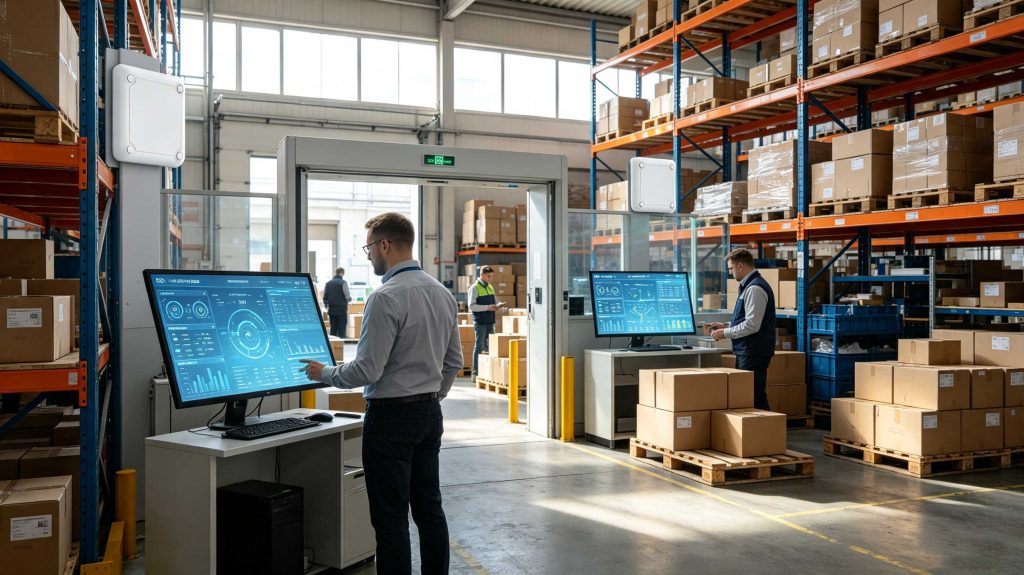
A successful RFID project requires software integration.
Common connections:
- ERP
- WMS
- Inventory databases
- Retail systems
Frequently Asked Questions About How RFID Is Used in Inventory Management
1. How RFID is used in inventory management?
RFID is used in inventory management by attaching RFID tags to products and using readers to automatically collect product information, track movement, and update inventory records in real time.
2. Does RFID improve inventory accuracy?
Yes. RFID reduces manual counting errors and provides more accurate product identification compared with traditional inventory methods.
3. Can RFID track inventory locations?
Yes. RFID systems can record inventory movement events and help businesses understand where products are located within operational areas.
4. Is RFID better than barcode for warehouse inventory?
RFID provides advantages for large-scale inventory operations because it supports automatic multi-item identification and reduces manual scanning.
5. What industries use RFID inventory systems?
RFID inventory systems are used in retail, healthcare, logistics, manufacturing, automotive, libraries, and asset management.
6. Do RFID tags need batteries?
Most inventory RFID tags are passive tags. They receive energy from RFID readers and do not require internal batteries.
7. Why choose Cykeo RFID inventory solutions?
Cykeo provides UHF RFID readers, modules, antennas, and integrated RFID solutions designed for accurate, scalable inventory management.
Building Intelligent Inventory Management with RFID
Inventory management is moving from periodic counting toward continuous visibility.
Businesses need accurate information at every moment:
- What products exist
- Where products are located
- When inventory changes happen
RFID creates this connection between physical inventory and digital systems.
The answer to how rfid is used in inventory management is straightforward: RFID uses electronic tags, wireless readers, and software platforms to automate identification, improve accuracy, and provide real-time inventory visibility.
Cykeo RFID technology helps companies build smarter inventory systems for retail, healthcare, logistics, and industrial environments.


评论
发表评论