RFID Asset Tracking Manufacturing: How Manufacturers Achieve Complete Asset Visibility
RFID asset tracking manufacturing enables factories to identify, locate, and manage production assets automatically with minimal human intervention. Properly implemented RFID systems improve inventory accuracy, reduce equipment loss, shorten search time, and provide real-time visibility across manufacturing operations.
Unlike barcode systems that require line-of-sight scanning, RFID identifies tagged assets automatically while they move through production, storage, maintenance, or shipping. In today’s high-mix manufacturing environments, that difference translates directly into measurable operational efficiency.
As engineers at Cykeo, we have participated in RFID deployments across manufacturing plants, warehouse automation projects, maintenance workshops, and industrial logistics centers. One lesson becomes obvious after every implementation: manufacturers rarely underestimate RFID’s reading speed—but they often underestimate the operational value of having trustworthy asset data available every second.
Why is RFID Asset Tracking Manufacturing Becoming Essential?
Manufacturers today face increasing pressure to improve productivity while controlling operating costs. Asset visibility directly affects production uptime.
According to McKinsey & Company, manufacturers adopting Industry 4.0 technologies—including IoT identification technologies such as RFID—can achieve productivity improvements ranging from 15% to 30% depending on application maturity.
Meanwhile, GS1, the global organization responsible for supply chain identification standards, identifies RFID as one of the most effective automatic identification technologies for improving inventory accuracy and traceability throughout manufacturing and logistics.
These findings align closely with what we observe during customer deployments. Facilities often discover that the largest inefficiencies are not caused by missing equipment—but by the time employees spend searching for it.
How RFID Asset Tracking Manufacturing Works
1. Every Asset Receives a Unique Digital Identity
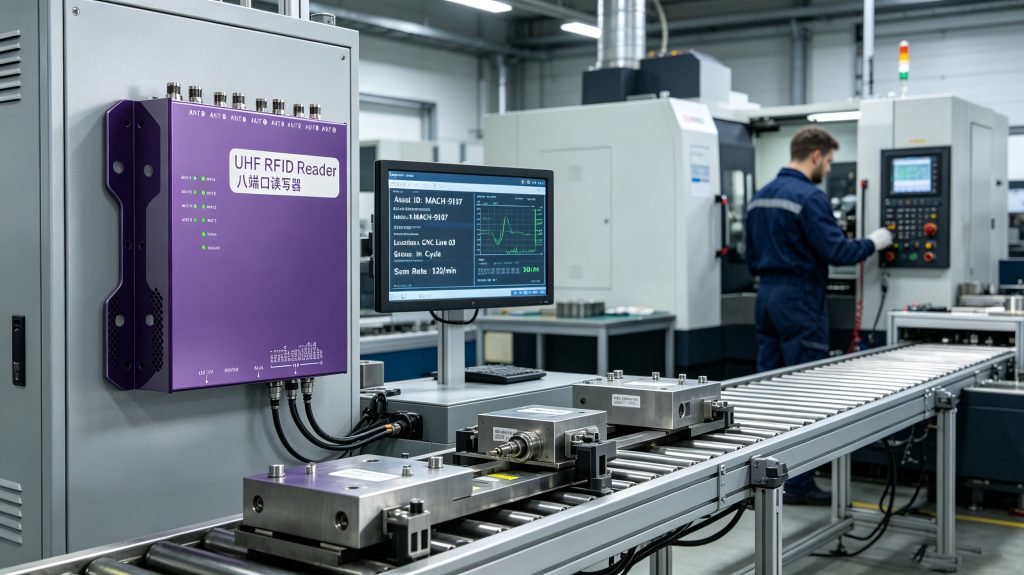
Each production asset—whether a mold, fixture, tool cart, returnable container, or inspection instrument—is equipped with a unique RFID tag containing an Electronic Product Code (EPC).
2. RFID Readers Capture Movement Automatically
Fixed RFID readers installed at:
- Production entrances
- Warehouse doors
- Maintenance stations
- Assembly cells
- Shipping docks
automatically record asset movement without requiring manual scanning.
Because UHF RFID supports bulk reading, dozens or even hundreds of tagged assets can be identified within seconds.
3. Software Builds Real-Time Visibility
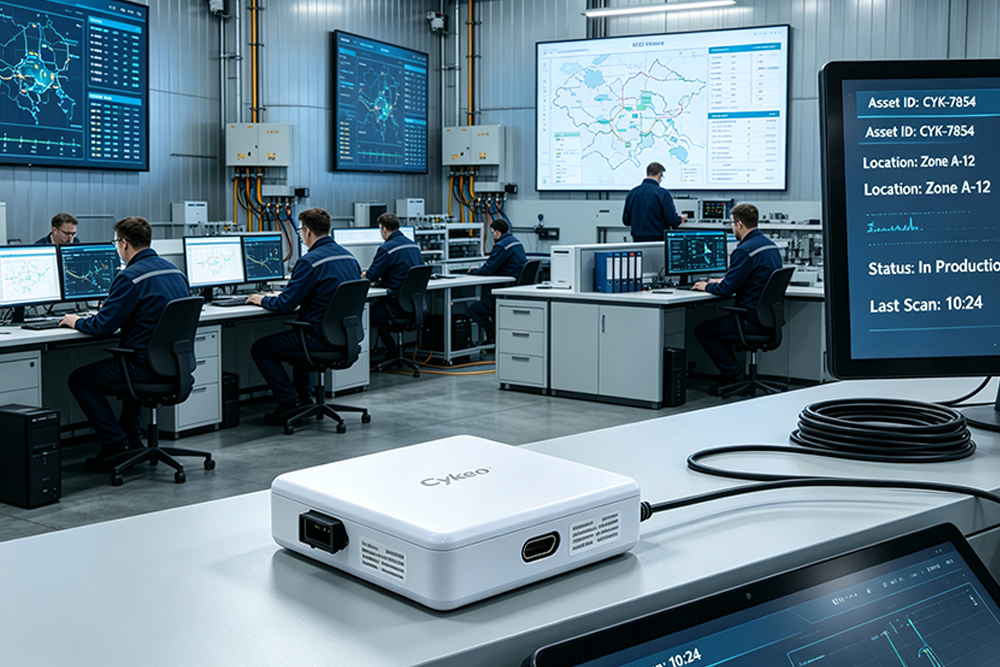
Every RFID event updates the manufacturing database instantly.
Managers can immediately answer questions like:
- Where is Machine Tool #204?
- Which assembly line currently uses Mold A17?
- Has Calibration Device B already entered maintenance?
- Which returnable container has not returned from supplier?
Instead of relying on spreadsheets, decisions are based on live operational data.
Which Manufacturing Assets Benefit Most?
| Asset Type | Typical RFID Benefit |
|---|---|
| Production Tools | Prevent loss and unauthorized movement |
| Returnable Containers | Improve circulation efficiency |
| Dies & Molds | Faster location and maintenance scheduling |
| Test Equipment | Calibration traceability |
| Forklifts | Utilization monitoring |
| Work-in-Process Carriers | Production visibility |
| IT Equipment | Automated inventory |
| Maintenance Parts | Stock accuracy |
Lessons We’ve Learned from Factory Deployments
During one electronics manufacturing project, maintenance technicians estimated they spent “only a few minutes” locating specialized fixtures.
Actual RFID data told a different story.
After monitoring equipment movement for several weeks, the average search time exceeded 20 minutes per technician each day. The lost productivity had simply become accepted as routine.
Installing RFID portals at maintenance exits immediately exposed where fixtures accumulated. No additional labor was required—the data already existed once assets became visible.
That experience reinforced an important point:
RFID does not create efficiency by itself.
It exposes operational behavior that factories previously could not measure.
Why Manufacturers Choose UHF RFID Instead of Barcodes
| Barcode | RFID |
|---|---|
| Line-of-sight required | No line-of-sight |
| One item at a time | Hundreds simultaneously |
| Manual scanning | Automated identification |
| Easy to damage | Industrial-grade tags available |
| Limited automation | Supports unattended operation |
For factories operating multiple production shifts, these differences significantly reduce labor requirements while improving inventory consistency.
Frequently Asked Questions
Can RFID work around metal equipment?
Yes. Industrial on-metal RFID tags are specifically designed for metal surfaces and are widely used in manufacturing, aerospace, energy, and automotive industries.
How accurate is RFID asset tracking?
System accuracy depends on tag selection, antenna placement, and software configuration. Properly engineered manufacturing deployments routinely achieve inventory accuracy above 99%.
Does RFID replace ERP or MES?
No. RFID supplies real-time identification data that integrates with ERP, MES, WMS, and CMMS platforms, improving data quality rather than replacing enterprise software.
Is RFID suitable for harsh industrial environments?
Absolutely. Industrial RFID readers and rugged tags are available with IP-rated enclosures capable of operating in dusty, humid, or outdoor manufacturing environments.
Why Cykeo Supports Industrial RFID Manufacturing Projects
Cykeo develops industrial RFID hardware specifically for demanding manufacturing applications, including fixed UHF RFID readers, embedded RFID modules, industrial antennas, handheld readers, and RFID tags compatible with global EPC standards.
Our engineering team works directly with OEM manufacturers, system integrators, and automation providers to optimize antenna layouts, reading zones, communication interfaces, and software integration before deployment begins. That practical engineering involvement helps customers avoid many of the installation issues commonly encountered in large-scale factory projects.
Rather than recommending identical configurations for every customer, we evaluate production flow, asset types, environmental conditions, and integration requirements before selecting hardware. In manufacturing, reliable RFID performance is determined long before the first reader is powered on.
Final Answer
RFID asset tracking manufacturing has become one of the most practical technologies for improving production visibility, reducing manual inventory, and increasing equipment utilization. When designed around real manufacturing workflows instead of generic automation concepts, RFID delivers reliable operational intelligence that supports smarter, faster factory decisions. Cykeo combines industrial RFID hardware with deployment experience to help manufacturers build scalable, high-performance asset tracking systems.
Author
Written by the Cykeo Industrial RFID Engineering Team
The Cykeo engineering team specializes in UHF RFID hardware development, industrial automation, smart manufacturing, warehouse logistics, and enterprise asset visibility. Our engineers have supported RFID deployments across manufacturing plants, logistics centers, tool management systems, healthcare facilities, and industrial IoT projects worldwide.


评论
发表评论