How Do RFID Tags Work: Understanding Wireless Identification Technology
How do RFID tags work? RFID tags work by storing digital information in a chip and communicating wirelessly with RFID readers through radio frequency signals for automatic identification, tracking, and data management.
RFID tags are small but highly important components in modern identification systems. They connect physical objects with digital information, allowing companies to know what an item is, where it moves, and when it is recorded.
At Cykeo, our engineers have tested RFID tags across different environments including warehouses, textile factories, libraries, power equipment management, and industrial asset tracking projects. In these applications, we learned that choosing the right RFID tag is not only about reading distance. Material, installation position, antenna design, and surrounding interference all influence actual performance.
A tag attached to a cardboard box behaves differently from one installed on metal equipment. The technology remains the same, but the application changes the engineering requirements.
According to GS1, RFID enables automatic identification by exchanging information between electronic tags and readers through radio frequency communication. This capability has made RFID an important technology in supply chain and asset management.
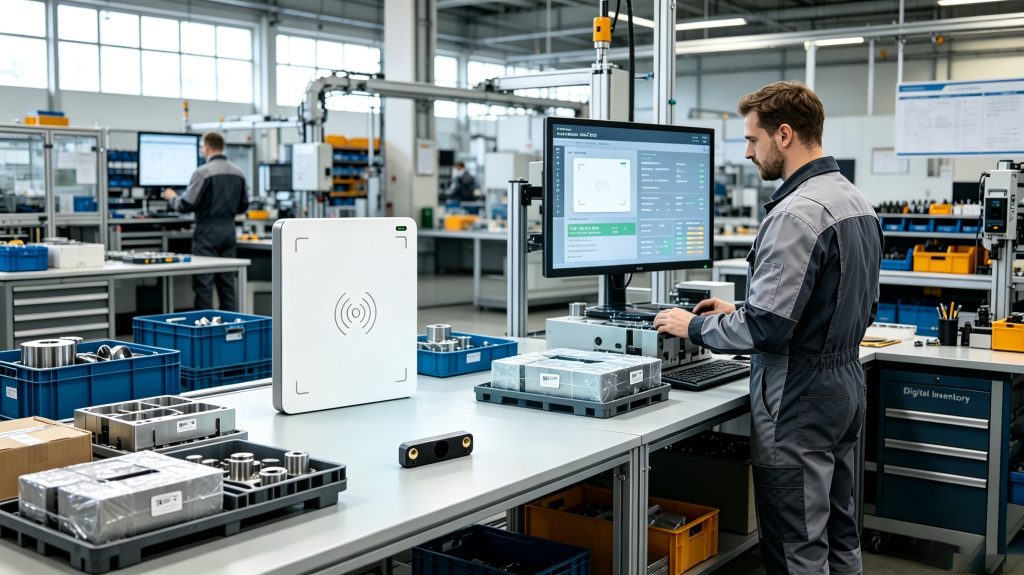
How Do RFID Tags Work Step by Step?
RFID Tag Communication Process Explained
An RFID tag system works through interaction between the tag and reader.
The process normally includes four stages:
| Stage | What Happens |
|---|---|
| 1. Signal Transmission | RFID reader sends radio frequency energy |
| 2. Tag Activation | RFID tag receives the signal and activates its chip |
| 3. Data Response | Tag sends stored identification information back |
| 4. System Processing | Software records and manages the data |
Unlike traditional barcode labels, RFID tags do not require direct visual scanning.
A warehouse worker does not need to manually scan every product one by one. Instead, tagged items can be automatically identified when passing through an RFID reading area.
This difference becomes especially valuable in industries handling thousands of items daily.
What Is Inside an RFID Tag?
RFID Tag Components and Structure
An RFID tag usually contains three key parts:
| Component | Function |
|---|---|
| RFID Chip | Stores identification data |
| Rfid Antenna | Receives and sends radio signals |
| Substrate / Housing | Protects internal components |
Different applications require different tag structures.
Examples:
| Application | Recommended RFID Tag Type |
|---|---|
| Clothing management | Flexible UHF RFID tags |
| Metal tools | Anti-metal RFID tags |
| Library books | HF RFID tags |
| Outdoor equipment | Durable industrial RFID tags |
At Cykeo, RFID tag selection is usually based on the real working environment rather than only technical specifications.
For example, metal surfaces can affect UHF RFID performance because they change electromagnetic behavior. In such cases, specialized anti-metal tags are required.
How Do Passive RFID Tags Work Without Batteries?
Passive RFID Tag Technology
Most RFID tags used in inventory and logistics are passive RFID tags.
They do not contain batteries.
Instead, they receive energy from the RFID reader signal.
The communication process works like this:
- Reader creates an electromagnetic field.
- Tag antenna captures energy.
- RFID chip activates.
- Stored information is transmitted back.
Passive tags are popular because they are:
- Lightweight
- Low maintenance
- Cost effective
- Suitable for large-scale deployment
This makes them widely used in:
- Supply chain management
- Retail inventory
- Manufacturing tracking
- Asset identification
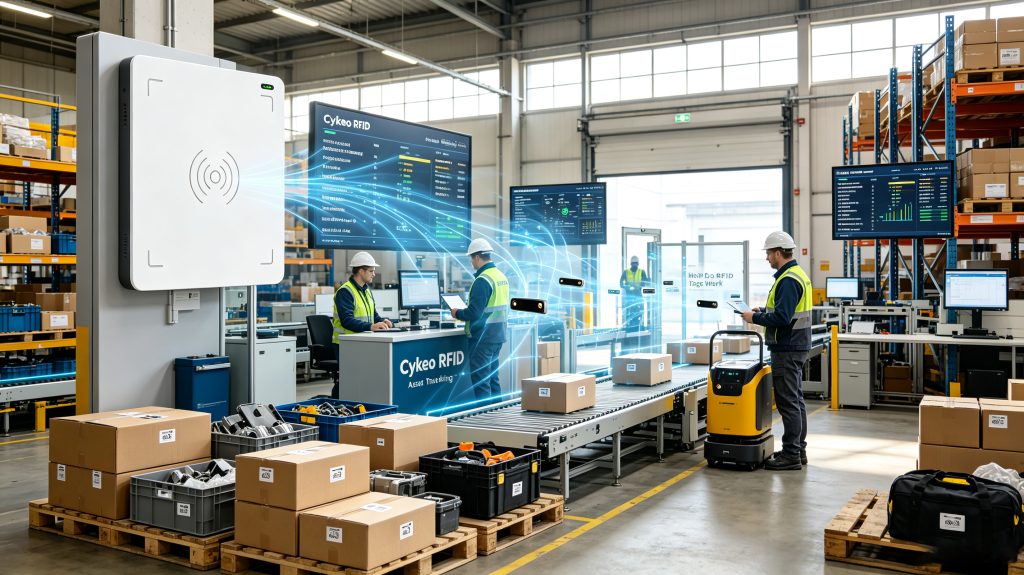
Different Types of RFID Tags and Their Working Methods
RFID Tag Frequency Categories
RFID tags are commonly divided by operating frequency.
| RFID Type | Frequency | Common Applications |
|---|---|---|
| LF RFID | 125–134 kHz | Access systems, animal identification |
| HF RFID | 13.56 MHz | Library systems, smart cards, NFC |
| UHF RFID | 860–960 MHz | Inventory, logistics, asset tracking |
UHF RFID tags are especially important for industrial applications because they support longer reading distances and fast multi-tag identification.
Cykeo UHF RFID solutions are designed for environments where companies need reliable identification of large numbers of products.
Why Do Companies Use RFID Tags?
Benefits of RFID Tag Systems
RFID tags provide advantages that traditional identification methods cannot easily achieve.
Faster Data Collection
Multiple RFID tags can be identified automatically.
Reduced Manual Work
Employees spend less time scanning and recording items.
Improved Inventory Visibility
Companies can connect physical assets with digital records.
Better Process Control
RFID data helps businesses monitor movement and status.
Research from Auburn University RFID Lab has shown that RFID adoption can improve inventory accuracy and supply chain visibility when properly implemented.
Cykeo Engineering Experience With RFID Tags
Real RFID Deployment Knowledge
Many customers ask us, “How do RFID tags work?”
The technical answer is simple: tags communicate through radio frequency signals.
The practical answer is more complex.
During RFID deployment, our engineers often inspect details that are invisible during initial planning:
- A stainless-steel surface near the tag
- A crowded storage rack
- Liquid products affecting signal behavior
- Different tag orientations during movement
One project involved tracking industrial tools where tags had to survive daily handling while maintaining reliable identification. The challenge was not creating a signal. The challenge was creating a stable system around real human workflows.
That experience shapes how Cykeo designs RFID solutions today.
FAQ About How Do RFID Tags Work
Do RFID tags need a power source?
Passive RFID tags do not require batteries. They receive energy from RFID readers during communication.
Can RFID tags be rewritten?
Yes. Some RFID tags support writing new information through compatible RFID readers.
How far can RFID tags be read?
Reading distance depends on tag type, frequency, reader power, antenna design, and environment.
Can RFID tags work on metal products?
Yes, but special anti-metal RFID tags are usually required for reliable performance.
Conclusion
How do RFID tags work? RFID tags work by storing information in an electronic chip and exchanging data with RFID readers through wireless radio frequency communication.
From warehouse inventory to industrial asset management, RFID tags create a connection between physical products and digital systems.
Cykeo combines RFID engineering experience, hardware development capability, and real application testing to help businesses build reliable identification solutions.


评论
发表评论