RFID Key Tracking: The Small Change That Solves Surprisingly Expensive Problem
If you’ve ever watched someone spend twenty minutes searching for a missing vehicle key or equipment room key, you already understand the hidden cost of poor key management.
At first glance, a metal key doesn’t seem valuable. But when that key opens a warehouse, a fleet vehicle, a data center cabinet, or restricted machinery, losing it can interrupt operations, create security risks, and waste hours of staff time.
That’s probably why RFID key tracking has been gaining attention across manufacturing plants, logistics centers, hospitals, universities, and government facilities. Instead of relying on handwritten logs or memory, organizations can know where keys are, who removed them, and whether they have been returned.
The technology itself isn’t especially new. What’s changed is that RFID hardware has become more affordable and software has become much easier to integrate into daily workflows.
Why Traditional Key Management Starts Breaking Down
A notebook beside a key cabinet works well—until the office gets busy.One employee forgets to sign out a master key. Another borrows a vehicle key during an emergency. Someone else places the wrong key back on the rack.
Eventually nobody knows which record is accurate.
I once visited a warehouse where maintenance staff had taped handwritten numbers onto hundreds of keys. Every Friday afternoon, two supervisors spent nearly an hour confirming everything was present. They didn’t realize the audit itself was costing more than the occasional lost key.
This kind of scenario is surprisingly common.
RFID changes the process because identification happens automatically instead of depending on manual recording.
So, What Is RFID Key Tracking?
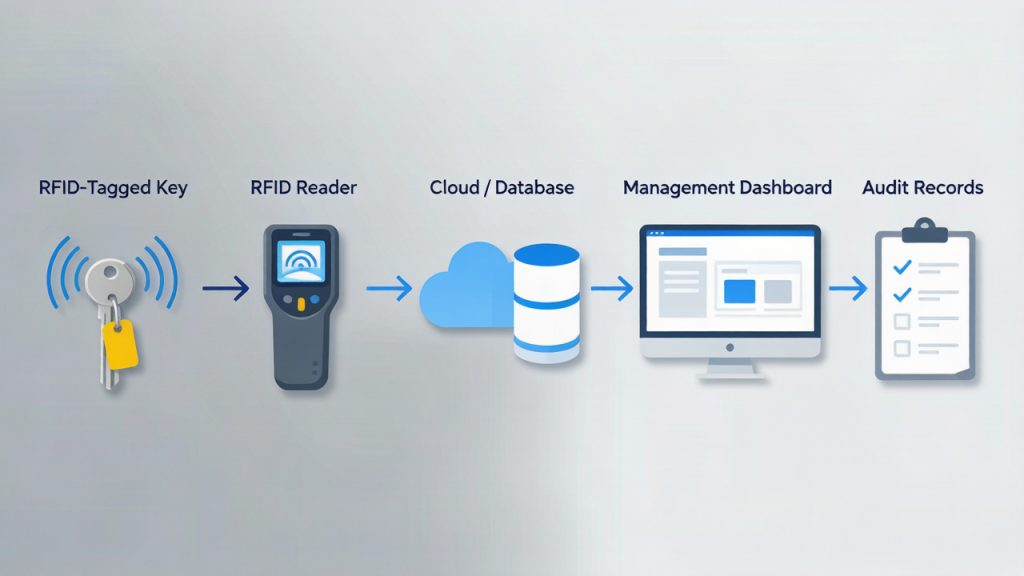
In simple terms, RFID key tracking combines three elements:When a tagged key enters or leaves the reading zone, the system detects it automatically. Staff no longer need to scan each key individually or fill out paper logs.
Depending on deployment, events can trigger notifications, update databases in real time, or synchronize with broader asset management platforms.
Passive RFID or Active RFID?
For key management, passive RFID is usually enough.Passive tags don’t require batteries, remain lightweight, and can last for years. They’re also inexpensive enough to deploy across hundreds or thousands of keys.
Active RFID, which contains its own power source, can transmit over much longer distances. It’s useful for tracking moving equipment across large campuses but is generally unnecessary for individual keys because of higher cost and maintenance requirements.
Choosing the wrong technology often leads to overspending rather than better results.
The Biggest Benefit Isn’t Finding Lost Keys
Many buyers initially expect RFID to work like GPS.It doesn’t.
Most RFID key tracking systems identify when keys pass designated reading locations rather than continuously broadcasting their position.
Oddly enough, that’s often more useful.
For example:
Answering these questions quickly prevents disputes and improves accountability.
Real-World Situations Where RFID Key Tracking Makes Sense
Different industries use the same technology in surprisingly different ways.Fleet Management
Transportation companies often manage hundreds of vehicle keys across multiple shifts.RFID records check-out and return activity automatically, reducing delays when drivers change over.
Manufacturing Facilities
Production supervisors may control access to electrical rooms, maintenance panels, specialized tools, or machine control keys.Instead of searching cabinets manually, they receive immediate inventory visibility.
Hotels and Property Management
Master keys, backup room keys, maintenance access keys, and contractor credentials all require careful monitoring.RFID helps maintain accountability without creating extra paperwork.
Healthcare
Hospitals frequently manage pharmaceutical cabinets, laboratory access, emergency vehicles, and specialized equipment rooms.Knowing exactly which authorized employee accessed which key simplifies compliance reporting.
Warehouses and Distribution Centers
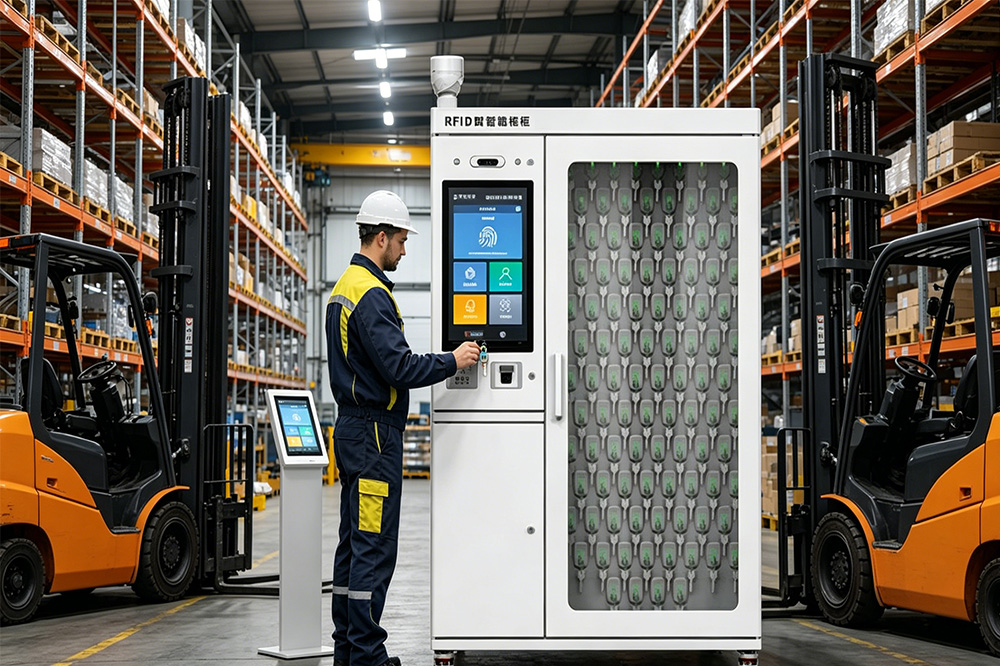
Busy logistics operations often coordinate trailers, cages, forklifts, loading docks, and secure storage areas.RFID integrates naturally into inventory workflows already used for pallets and assets, making key tracking another automated data point rather than a separate process.
What About Security?
This is where misconceptions appear.An RFID key tag by itself doesn’t secretly follow employees around a building.
Most deployments record interactions only when the tag passes an installed reader or checkpoint. Without nearby readers, there’s typically no event to capture.
Security depends more on system design than on the tag itself.
Organizations should define access permissions, encryption where appropriate, audit logs, and user authentication policies alongside RFID deployment.
Technology alone won’t solve procedural weaknesses.
Common Components of an RFID Key Tracking Solution
Although configurations vary, many enterprise deployments include:Some organizations also combine facial recognition, QR code verification, or touch-screen interfaces to simplify user interaction.
A Short Example
Imagine a utility company operating 80 service vehicles.Every morning, technicians queue up to collect keys from a central office.
Before RFID, the dispatcher manually checked names against paper sheets. During busy periods, mistakes happened almost daily.
After implementing RFID, each technician authenticates, removes the assigned key, and the software records the event instantly. At closing time, any missing keys appear automatically in an exception report.
No one spends an hour counting hooks on the wall anymore.
The process feels almost invisible, yet accountability improves dramatically.
Mistakes Companies Make During Deployment
Ironically, the technology isn’t usually the hardest part.The larger challenge is planning.
Some companies attach tags without defining workflows. Others install readers but never establish return policies or exception handling.
A few practical suggestions:
Small pilot projects often reveal issues that would otherwise become expensive after a full rollout.
Can RFID Scale Beyond Keys?
Absolutely.Once the infrastructure exists, many organizations expand RFID to tools, laptops, IT assets, maintenance equipment, medical devices, reusable containers, or warehouse inventory.
The same readers that identify key tags may also support broader asset visibility, creating additional return on investment over time.
Is RFID Key Tracking Worth It?
For a business with five office keys, probably not.For an organization managing hundreds or thousands of critical keys across multiple departments, the calculation changes quickly.
Reduced search time, fewer losses, automatic audit trails, and stronger accountability can save far more than the hardware investment over the system’s lifetime.
In practice, many managers discover that the biggest improvement isn’t simply locating keys—it’s eliminating uncertainty.
When everyone knows where responsibility begins and ends, operations tend to run more smoothly.
Looking for an RFID Key Tracking Partner?
If you’re sourcing RFID key tracking solutions for industrial, commercial, or enterprise applications, consider suppliers that offer:For distributors, system integrators, and enterprise buyers, selecting flexible hardware with proven compatibility often matters more than choosing the most feature-heavy platform.


评论
发表评论