RFID chip animals technology provides permanent, contactless identification for pets and livestock, enabling fast tracking, accurate record management, and improved traceability across farms, veterinary clinics, and animal welfare programs.
For organizations managing hundreds or thousands of animals, RFID identification has become the most practical method for maintaining accurate records without relying on visual inspections or handwritten logs.
As an RFID engineer with more than 10 years of experience deploying RFID systems in agriculture, livestock facilities, and animal identification projects, I have seen RFID reduce manual registration time from hours to minutes while significantly improving data accuracy.
RFID chip animals refers to animals identified through RFID-enabled microchips or electronic tags containing a unique identification number.
Unlike traditional ear tags or printed labels, RFID identification allows data to be captured automatically without direct contact.
Common applications include:
- Pet identification
- Livestock management
- Breeding programs
- Veterinary record management
- Wildlife monitoring
- Animal movement tracking
- Disease control programs
According to the United States Department of Agriculture (USDA), animal traceability systems play a critical role in disease response and livestock movement management.
How RFID Animal Identification Works
The process is straightforward:
- An RFID chip or tag is assigned to an animal.
- A reader emits radio frequency signals.
- The RFID chip responds with a unique ID.
- Software links the ID to animal records.
This entire process typically takes less than one second.
RFID Adoption in Modern Animal Management
In many European livestock facilities, RFID identification has moved beyond compliance requirements and become an operational necessity.
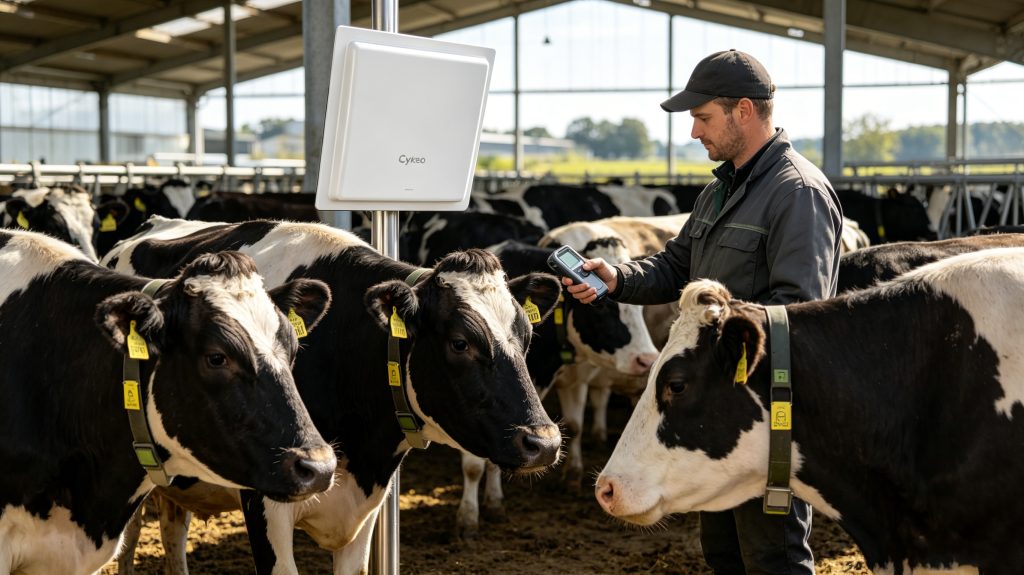
During a recent deployment visit to a dairy operation, workers previously spent nearly two hours every morning verifying livestock records manually. After RFID implementation, animal identification was completed in minutes.
The improvement wasn’t simply speed.
The real advantage was confidence in the data.
According to the Food and Agriculture Organization (FAO), digital livestock traceability improves transparency throughout agricultural supply chains and supports disease monitoring programs.
Typical RFID Animal Applications
| Application | RFID Benefit |
|---|---|
| Pet Registration | Permanent identification |
| Dairy Farms | Automated herd management |
| Beef Cattle Tracking | Movement monitoring |
| Veterinary Clinics | Fast patient retrieval |
| Wildlife Research | Long-term identification |
| Breeding Operations | Accurate genealogy records |
Why RFID Outperforms Traditional Animal Tags
Visual tags work until they become dirty, damaged, or unreadable.
RFID continues functioning without requiring direct visibility.
Key advantages include:
Faster Identification
Multiple animals can be processed rapidly during feeding, weighing, or veterinary inspections.
Improved Data Accuracy
Manual data entry errors are dramatically reduced.
Better Disease Traceability
Animal movement records become available instantly.
Reduced Labor Costs
Fewer personnel are required for inventory and registration activities.
According to the World Organisation for Animal Health (WOAH), traceability systems are increasingly important for animal health management and international trade compliance.
RFID Tags vs RFID Microchips
RFID Ear Tags
Commonly used in:
- Cattle
- Sheep
- Goats
- Deer
Advantages:
- Easy visual confirmation
- Cost-effective
- Large-scale deployment
RFID Microchips
Commonly used in:
- Dogs
- Cats
- Horses
- Companion animals
Advantages:
- Permanent implantation
- Difficult to remove
- Long operational life
For pet identification, ISO 11784 and ISO 11785 standards remain the global benchmark for RFID animal microchips.

How Cykeo Supports RFID Animal Management
Cykeo RFID readers are designed to support high-performance animal identification systems requiring:
- Fast tag recognition
- Reliable read performance
- Multi-tag processing
- Long operational stability
- Integration with management software
In large-scale livestock environments, reader consistency matters more than peak laboratory performance.
Field conditions include:
- Dust
- Moisture
- Metal structures
- Animal movement
Reliable data capture under those conditions is what determines project success.
Frequently Asked Questions About RFID Chip Animals
Can RFID chips track animal GPS location?
No.
Standard RFID chips store identification data only. They do not contain GPS functionality.
Are RFID animal chips safe?
Yes.
RFID animal microchips have been used globally for decades and are widely accepted by veterinary organizations.
How long does an RFID chip last?
Most passive RFID animal chips are designed to operate for the lifetime of the animal.
Can RFID identify multiple animals at once?
Yes.
Modern RFID readers can identify multiple tagged animals simultaneously, depending on system configuration.
What is the difference between RFID ear tags and microchips?
Ear tags are externally attached and visible. Microchips are implanted beneath the skin and provide permanent identification.
Final Thoughts
For farms, veterinary organizations, breeding facilities, and animal welfare programs, rfid chip animals technology has become one of the most effective tools for identification and traceability. Combined with professional RFID readers and management software, RFID enables faster operations, more accurate records, and scalable animal management across virtually any environment.
Cykeo continues to support organizations worldwide with reliable RFID solutions built for real-world animal identification applications.


评论
发表评论