RFID Library Solutions: How Smart Libraries Are Built Today
Introduction
Walk into a modern library today, and something feels different.
There are fewer queues.
Books move faster.
Staff spend less time scanning—and more time helping people.
What changed?
Behind the scenes, many libraries have quietly adopted RFID library solutions. It’s not flashy, but it completely changes how a library runs.
What Are RFID Library Solutions?
RFID library solutions are systems that use radio frequency technology to manage books, assets, and user interactions automatically.
Instead of scanning books one by one, RFID allows multiple items to be read at once—no alignment, no waiting.
Each book has a small RFID tag inside. When it passes near a reader, it’s instantly identified and recorded.
That simple change unlocks a lot of improvements.

Why Libraries Are Moving to RFID
Traditional library workflows are slow and manual:
- Checking books one by one
- Time-consuming inventory checks
- Misplaced books hard to find
- Long queues during peak hours
RFID solves these problems in a very practical way.
What actually improves:
- Faster borrowing & returns
- Real-time inventory visibility
- Better accuracy in shelving
- Reduced labor workload
- Built-in anti-theft security
In many cases, users can place a stack of books on a reader and complete checkout in seconds.
How RFID Is Used Inside a Smart Library
RFID isn’t just one device—it’s a system made of several working parts.
1. RFID Tags (Inside Books)
Each book contains a passive RFID tag with a unique ID.
This allows the system to recognize every item individually.
2. RFID Readers & Antennas
Readers send signals, antennas create the coverage area.
They are used in:
- Self-checkout stations
- Book return systems
- Security gates
- Smart shelves
3. RFID Smart Cabinets
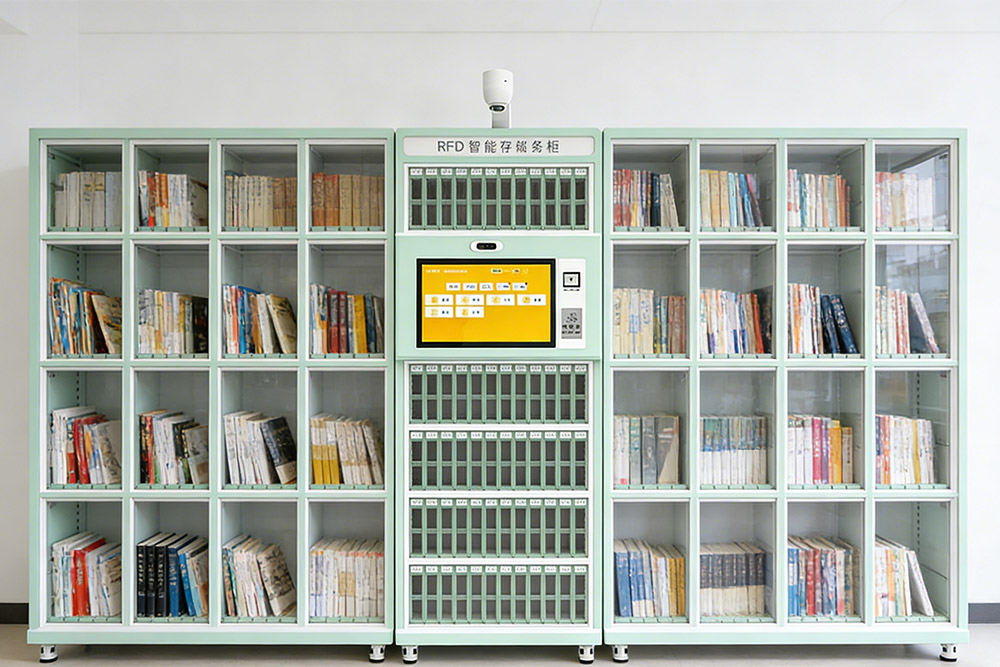
One of the most practical upgrades in modern libraries is the RFID smart cabinet.
Example product:RFID library Smart Cabinet solutions
What it does:
- Stores and manages books automatically
- Enables self-service borrowing
- Tracks inventory in real time
- Works as a mini unmanned library
In many deployments, these cabinets act like 24/7 self-service library stations, especially in schools, offices, or public spaces.
This is similar to how some cities deploy unattended library kiosks where users can borrow and return books anytime.
Real Use Cases of RFID Library Solutions
Self-Service Borrowing
Users place a stack of books on a reader → done in seconds.
No manual scanning. No waiting.
Automated Book Returns
Books pass through a return slot and are automatically:
- Identified
- Sorted
- Routed to the correct category
Some systems even connect to conveyor belts for sorting.
Smart Shelves
Shelves equipped with RFID antennas can detect:
- Which books are placed
- If a book is misplaced
- When items are removed
This reduces the time books stay “lost” inside the library.
Inventory Automation
Instead of scanning thousands of books manually, staff can:
- Walk with a handheld reader
- Or use automated systems
Some advanced systems even use robots to scan shelves with high accuracy.
How to Build an RFID Library System
If you’re planning a project, the process usually looks like this:
Step 1: Define the goal
- Faster checkout?
- Inventory accuracy?
- Unmanned service?
Step 2: Choose the right frequency
- HF (13.56 MHz) → common for libraries
- NFC → short-range, mobile-friendly
- UHF → longer range, more advanced use cases
Step 3: Select hardware
- RFID tags for books
- Readers and antennas
- Smart cabinets or kiosks
Step 4: Integrate with library system
RFID needs to connect with your LMS (Library Management System).
Step 5: Start small, then scale
Many libraries begin with one station, then expand.
What Makes RFID Library Solutions “Smart”
It’s not just automation—it’s visibility.
With RFID, libraries can:
- Know where every book is
- Track movement in real time
- Reduce human error
- Improve user experience
In short, it turns a traditional library into a data-driven system.
Challenges to Consider
RFID isn’t perfect, and real projects do run into issues:
- Initial tagging cost
- System integration complexity
- Staff training
- Special handling for old or fragile books
Some libraries even run barcode + RFID systems together during transition.
Final Thoughts
RFID library solutions aren’t about replacing people—they’re about removing repetitive work.
Once implemented, the difference is obvious:
- Faster service
- Better organization
- Less manual effort
And with tools like RFID library cabinets, libraries can extend their services beyond physical counters—into fully automated, self-service environments.


评论
发表评论