Warehouse RFID: How the Right UHF RFID Antenna Design Improves Pallet and Carton Scanning
A lot of warehouse RFID projects start with a simple expectation: pallets pass through a gate, tags get read, inventory updates automatically.
In theory, it sounds straightforward.
In practice, pallets don’t cooperate. Boxes are stacked irregularly. Tags face different directions. Forklifts move faster than expected. And sometimes the metal structure around the dock quietly destroys your read rates.
Over the years working with warehouse deployments, one lesson keeps repeating itself: the antenna design usually determines whether pallet scanning works smoothly—or becomes a constant troubleshooting exercise.
Pallet Tags Rarely Face the Same Direction
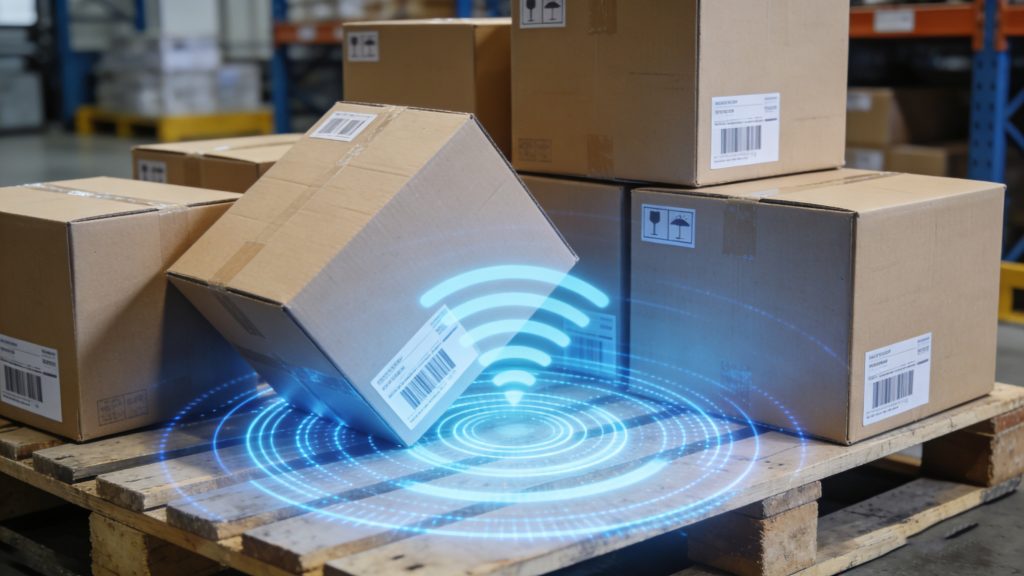
If you walk through a distribution center, you’ll notice something quickly: pallet labels are rarely consistent.
Some are placed on the front of cartons, some on the side. Some get partially covered by shrink wrap. Others are slightly bent or placed at an angle.
This inconsistency is why circularly polarized UHF RFID antennas are commonly used at dock doors and scanning gates. They tolerate tag orientation changes better than linear polarization.
Linear antennas can still work well when tag placement is standardized, but in mixed warehouse environments, orientation control is rarely perfect. Circular polarization gives you a little more forgiveness when reality gets messy.
Read Distance Is Not the Same as Read Control
One common mistake I see in warehouse projects is choosing antennas purely based on maximum read range.
Yes, high-gain antennas can read farther. But when scanning pallets moving through a gate, the goal is not “maximum distance.” The goal is controlled detection within a defined zone.
If the antenna reads too far, it may pick up tags from nearby pallets, staging areas, or forklifts waiting behind the gate. Suddenly your system logs inventory movement that never actually happened.
A controlled read zone is often more valuable than raw distance.
When evaluating hardware options, many integrators look for antennas with different gain levels and beam patterns—like the ones available on the Cykeo UHF RFID antenna product page—so they can match the antenna behavior to the physical layout of the dock door or conveyor.
Gate Layout Is Often More Important Than Antenna Specs
I’ve seen teams spend days comparing antenna specifications, while ignoring the physical layout of the RFID gate.
In warehouse environments, the structure around the gate matters just as much as the antenna itself.
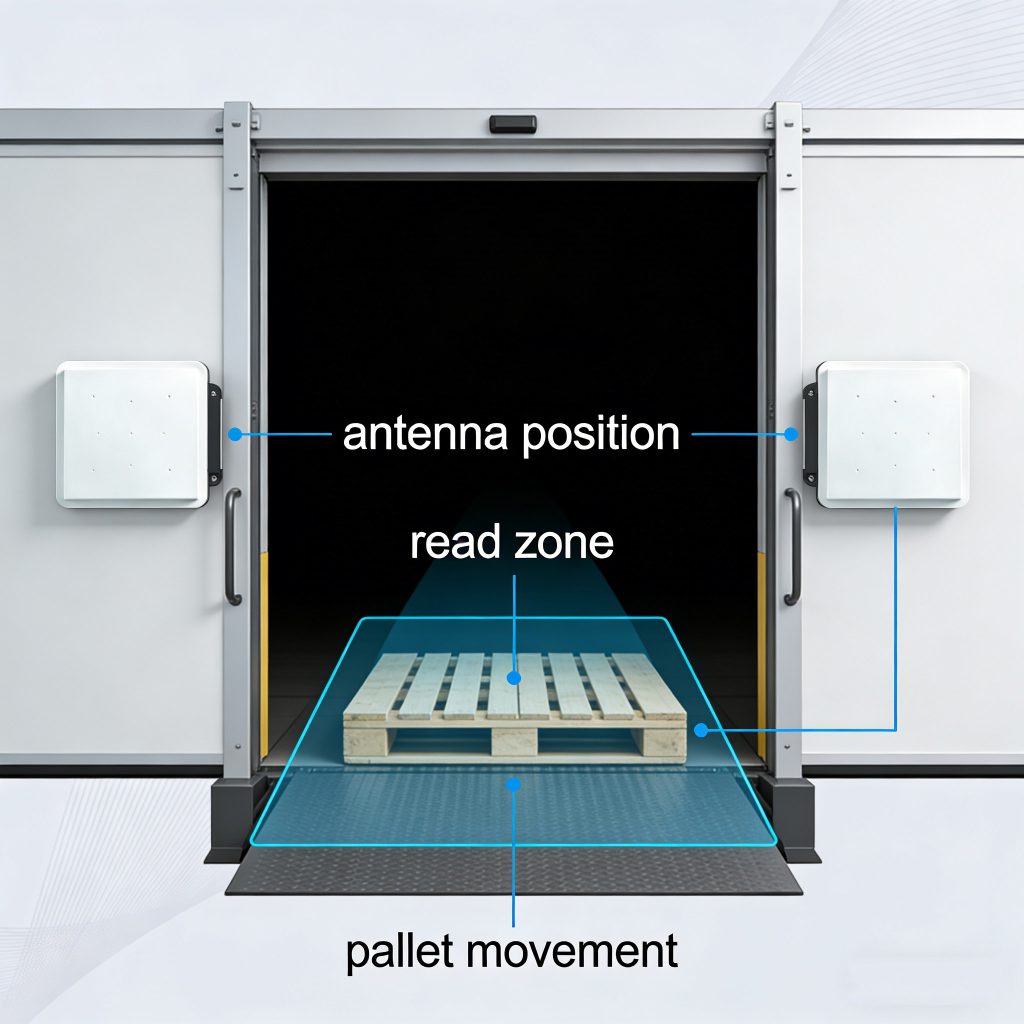
Metal frames, conveyor rails, pallet racks, and even nearby forklifts can reflect RF signals. This creates multipath effects where signals bounce around and produce inconsistent reads.
One practical trick many integrators use is slightly angling antennas toward the center of the pallet path rather than pointing them directly forward. That small adjustment often improves tag visibility across multiple carton surfaces.
Sometimes the best improvement is not a new antenna—it’s a different mounting angle.
Multi-Antenna Gates Require Balance
A typical RFID dock door uses two to four antennas. That number sounds simple, but placement quickly becomes a balancing act.
Too few antennas and some tags will fall into blind spots. Too many antennas and overlapping coverage can create unstable reads, especially when multiple readers are operating nearby.
A setup that often works well is positioning antennas diagonally across the gate so that each pallet side is exposed to at least one antenna field.
Different antenna models also provide different beam widths and mounting options. In warehouse deployments, integrators often choose antennas that allow flexible placement and directional control, such as the industrial UHF antenna options offered by Cykeo.
Flexibility during installation is more valuable than perfect specs on paper.
Conveyor Systems Introduce Another Layer of Complexity
Conveyor-based RFID tunnels behave differently from forklift gates.
Pallet gates deal with large objects moving at moderate speeds. Conveyor lines often involve smaller cartons moving quickly, sometimes only staying in the read zone for a second or two.
In these situations, antenna placement needs to focus on coverage consistency rather than long-range power.
A well-designed tunnel often uses multiple lower-power antennas positioned around the conveyor instead of one high-power antenna blasting the entire area.
Shorter read distances can actually improve accuracy because they reduce cross-reads from nearby conveyor lines.
Software Filtering Still Matters
Even with good antenna placement, warehouse RFID systems rely heavily on software filtering.
For example:
- Ignoring duplicate reads within a short time window
- Confirming reads from multiple antennas before triggering an event
- Defining directional movement through dock doors
Without these filters, even a well-designed antenna system may produce noisy data.
RF hardware detects signals. The software decides what those signals actually mean for inventory movement.
Final Thoughts from the Warehouse Floor
Warehouse RFID deployments succeed when antennas are treated as part of the system design—not just accessories attached to a reader.
When planning pallet or carton scanning projects, the most reliable setups usually focus on:
- Circular polarization for unpredictable tag orientation
- Controlled read zones rather than maximum distance
- Smart antenna angles and gate layout
- Balanced multi-antenna coverage
- Software filtering that supports the hardware behavior
RFID works extremely well in warehouses when the physical environment is respected.
And in many projects, the difference between a frustrating deployment and a stable one comes down to a few carefully chosen UHF RFID antennas and how thoughtfully they’re installed.


评论
发表评论