CK-R4 UHF RFID Fixed Reader: A Programmable RFID for Developers
For software developers, choosing an RFID reader isn’t about “how far it can read” or “how big the antenna is.” The real priorities are:
- Can I get data directly through an API?
- Can the device behavior be controlled by code?
- Is the interface stable for long-term projects?
- Is system integration hassle-free?
The CK-R4 UHF RFID Fixed Reader is designed with system integration and software development in mind. Its core value isn’t hardware specs—it’s a complete, open, production-ready RFID Reader API.
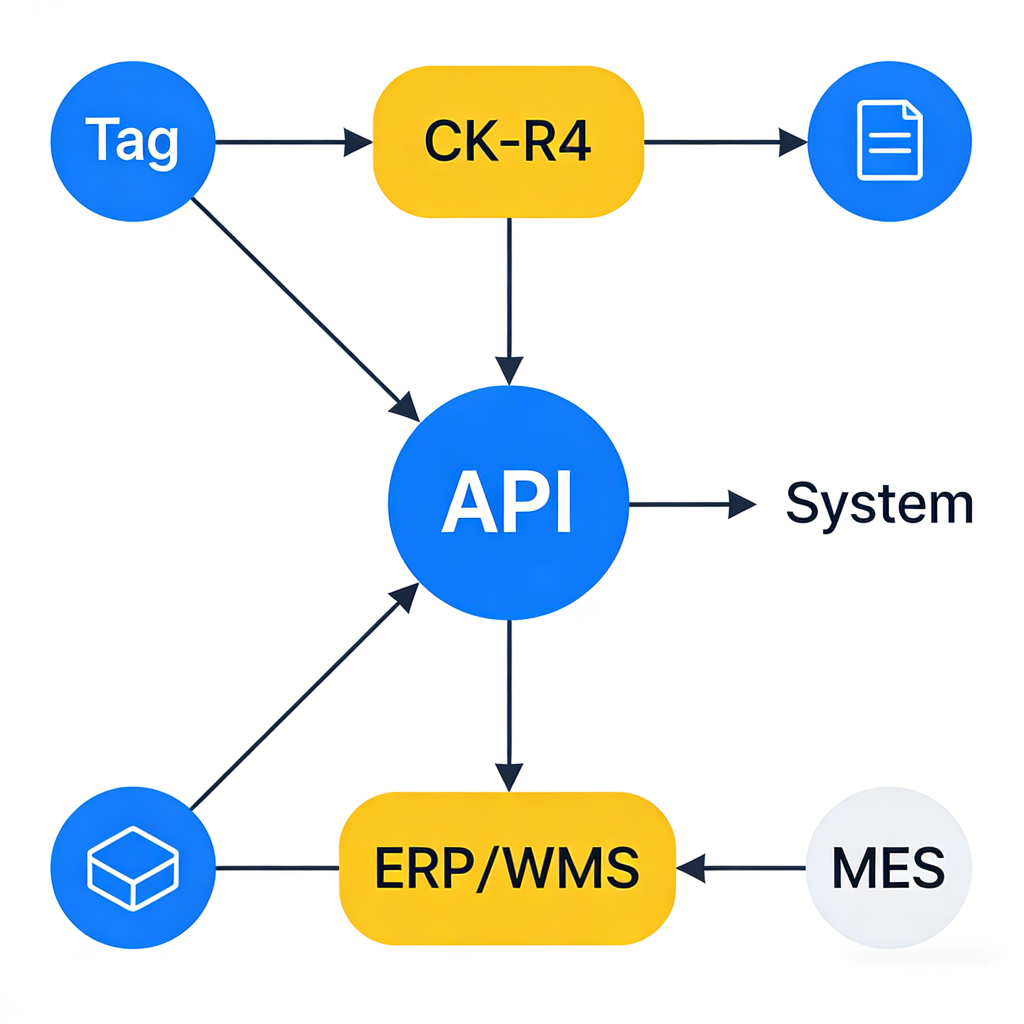
1. What CK-R4 Means for Developers
From a developer’s perspective, the CK-R4 is essentially an RFID data source + controllable device node.
It’s not the type of reader you have to operate manually via desktop software. Instead:
- Your system can directly call, configure, and manage it
- You can treat it as a “service node” in your system, not a manually operated piece of hardware
In other words, you can control it and get data directly from your code.
2. What the CK-R4 API Can Do
Real-Time Data Access
The CK-R4 API allows you to:
- Read EPC / TID / user memory data
- Read multiple tags simultaneously, suitable for high concurrency
- Deduplicate and filter tag data
- Continuous inventory or on-demand reading
What you get is structured data, ready to write to databases, message queues, or business logic—no need to parse raw RF signals.
Control the Device via Code
Developers care about control. With CK-R4, you can:
- Start / stop inventory
- Set antenna power
- Manage multi-antenna polling strategies
- Adjust reading frequency and working mode
This makes it more like a programmable RFID device rather than hardware you only tweak on-site.
Event-Driven Data Push
Most systems don’t want to poll devices constantly. CK-R4 can:
- Push data as soon as tags are read
- Output in JSON or other common formats
- Directly connect to your backend
Perfect for event-driven systems such as:
- RFID doors / access gates
- Warehouse entry/exit points
- Production line status triggers
3. Is the SDK Developer-Friendly?
The real question: How hard is it to develop with?
CK-R4 comes with a complete SDK and sample programs:
- Java / C# / .NET SDK
- Sample code + testing tools
You don’t need to start from serial protocols or low-level commands. With the SDK, you can directly:
- Connect to the device
- Fetch tag data
- Listen to events
- Configure parameters
This makes development cycles much more predictable.
4. Ideal Development Scenarios
CK-R4 is especially suitable for:
- WMS / warehouse systems (automated in/out)
- MES / production systems (process tracking)
- RFID doors / access systems
- Asset management platforms
- Custom IoT / industrial systems
The common factor: RFID is part of the system, not a standalone tool.

5. Why CK-R4 is Developer-Friendly
- Clear API logic, not a black box
- Supports system-level, batch deployment
- Suitable for 24/7 operation
- Complete SDK, low entry barrier
- Easy integration with existing systems
This also means lower maintenance costs after deployment.
6. In a Nutshell
The CK-R4 UHF RFID Fixed Reader isn’t “a device for people”—it’s a “RFID reader for systems.”
If you’re a software developer building a system that relies on automated RFID identification, CK-R4’s API makes your system cleaner, more stable, and easier to deliver.


评论
发表评论