How Do Passive RFID Tags Work?
If you’ve ever wondered how stores, libraries, or warehouses keep track of items without scanning barcodes one by one, passive RFID tags are often the secret behind it. They may look like tiny stickers or small cards, but they pack a clever trick: they work without a battery.
What Is a Passive RFID Tag?
A passive RFID tag is basically a small chip attached to an antenna. Unlike active RFID tags, it doesn’t have its own power source. Instead, it “borrows” energy from an RFID reader nearby to function. This makes it super cheap, long-lasting, and maintenance-free—perfect for libraries, warehouses, and retail.
How Do Passive RFID Tags Work?
Here’s the simple version:
- The reader sends out a signal: When an RFID reader emits radio waves, the tag’s antenna catches them.
- Energy transfer: Those radio waves create a tiny electrical current in the tag’s antenna. This current powers the chip inside.
- Data transmission: Once powered, the chip sends back its stored information (like an ID number) to the reader by subtly reflecting the signal.
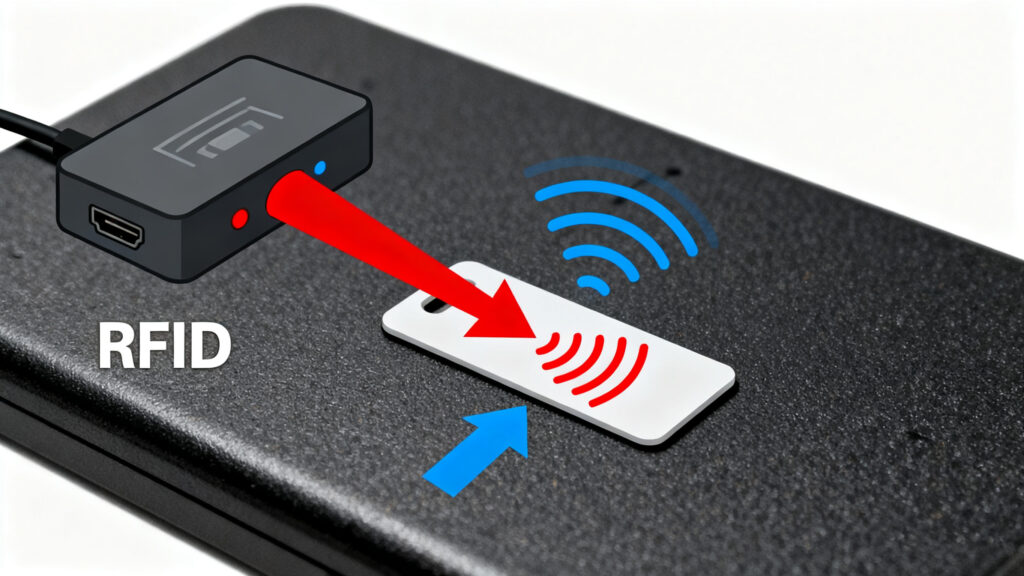
So, the tag works entirely off the energy from the reader—no batteries required.
Why Are Passive RFID Tags Useful?
Passive RFID tags are popular because they make tracking items fast and efficient:
- Libraries: Books with passive RFID tags can be borrowed or returned in seconds using a scanner. Inventory counts are also much faster.
- Retail and warehouses: Track inventory without manual scanning. Multiple items can be read at once.
- File or asset tracking: Important documents or equipment can be monitored easily.
- Supply chains: Monitor goods during transport, sometimes even integrating sensors for temperature or shock.
Advantages and Limitations
Advantages
- Low cost: No batteries mean cheaper tags.
- Long lifespan: Tags last for years without needing replacement.
- Maintenance-free: No charging or battery swaps required.
Limitations
- Limited reading distance: Usually a few centimeters to a few meters, depending on tag type and reader strength.
- Dependent on reader: The tag can’t function on its own; it needs the reader’s signal to work.
In Short
So, next time you borrow a book from a library or notice a store tracking items without scanning barcodes, you’re probably seeing passive RFID tags in action. They are small, clever, and surprisingly efficient: they capture energy from a reader, send back information, and make item tracking simple and quick.
Simply put: passive RFID tags work by using the reader’s energy to power themselves and communicate wirelessly—no battery needed.


评论
发表评论