RFID Antenna Design Unpacked: Theory · Practice · Lessons Learned
What is RFID antenna design
RFID antenna design is basically about creating antennas for RFID tags and readers — whether passive, semi-passive, or active. You have to think about frequency, structure, impedance, materials, environment, and a whole list of details. And trust me, it’s not just “draw it in CAD and run a sim.” The reality check comes with manufacturing errors, weird reflections, or a warehouse full of metal shelves killing your read range.
In papers (like “Antenna design for UHF RFID tags: A review …”) you’ll often see the same key elements: calculating read range, taking into account what the tag is stuck on (metal box, liquid container, or just plastic), tolerances in production, and the gap between simulations and real-world testing.

Key Principles in Theory
From different sources and my own projects, here are the big theoretical pieces:
- Frequency Band: UHF is around 860–960 MHz. Depending on where you are, laws say which slice you can use. Frequency affects size, wavelength, penetration, and loss.
- Antenna Geometry: Common ones are dipole, meander (zig-zag), loop, patch, or slot patch. Some designs fold traces, use slots, or layered structures just to work better on metal surfaces or save space.
- Impedance Matching: Tags have a weird complex impedance. You want the antenna to match it so energy transfer is maxed. Classic conjugate matching works, but new approaches tweak it to balance received power and backscatter performance. Sometimes you get 20%+ better read range that way.
- Materials & Substrates: FR4 is cheap and everywhere, but losses stack up at high frequency. High-end materials are more stable but cost more. Also, thickness, dielectric constant, copper thickness — all these shift the results.
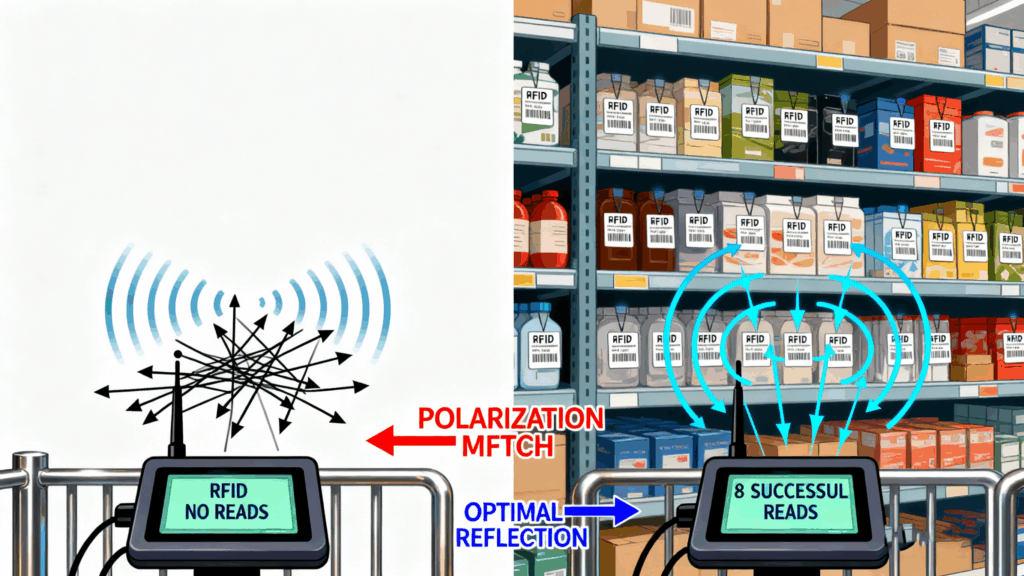
- Polarization & Gain: Linear vs circular polarization. If polarization doesn’t match between reader and tag, some tags just “disappear” at certain angles. High gain can help long distance, but can also create blind spots in dense tag setups.
Practical Steps & Field Lessons
From my own hands-on projects:
- Define the real use case
- How far do you need to read? Is the tag stuck on plastic bins, metal racks, fabric, or glass?
- Is there interference? Metal, water, reflections? Temperature swings?
- Do sims but build prototypes early
- CAD and EM simulation are great, but don’t trust them blindly.
- Make 2–3 prototypes, even crude ones, and measure them.
- Tune matching
- Use a VNA to measure return loss and resonant point.
- A tiny trim on copper trace, shifting a feed point, or adding a cap can move resonance by a lot.
- Don’t underestimate solder blobs or PCB tolerances.
- Cost vs performance
- For short range or low-volume projects, FR4 or simpler antennas may be fine.
- For big warehouses with lots of tags and long ranges, spend on material and design time.
- Field testing
- Lab results ≠ reality. I had a design that worked at 5m in the lab, but only 2–3m when mounted on a steel rack. Added absorber material + adjusted orientation + slightly shifted frequency to fix it.
- Regulations
- UHF frequencies differ per country. Don’t blast the wrong frequency or power — you can actually get in legal trouble.
Common Pitfalls & Fixes
| Problem | Likely Cause | Fix |
|---|---|---|
| Sim looks great but poor real reads | Ignored metal/liquid effects, wrong material assumptions, bad solder/feed connection | Do mock-ups, test in real environment, use absorber or spacing tricks |
| Matching shifts after production | PCB tolerance, copper thickness, humidity/temperature effects | Account for tolerance, leave tuning options (trim line, add small caps) |
| Tags “disappear” at certain angles | Polarization mismatch | Use circular polarization, test multiple orientations |
| High gain antenna but poor near coverage | Narrow beam misses close/side tags | Balance gain vs beamwidth, use multiple antennas |
Recent Trends
- Multi-layer structures: ring + periodic slots + folded traces, achieving wider bandwidth and more stable polarization.
- Smarter matching: instead of pure conjugate matching, optimizing for both received power and backscatter modulation.
- Miniaturization: meander and slot designs make antennas smaller without killing performance.
My Takeaways
RFID antenna design is part theory, part art, and a lot of field hacking. My personal lessons:
- Make prototypes early, not after weeks of sim.
- Polarization matters more than chasing max gain.
- Always keep adjustment space: trim lines, caps, feed shift.
- Write down test setups and results — you’ll thank yourself later.


评论
发表评论